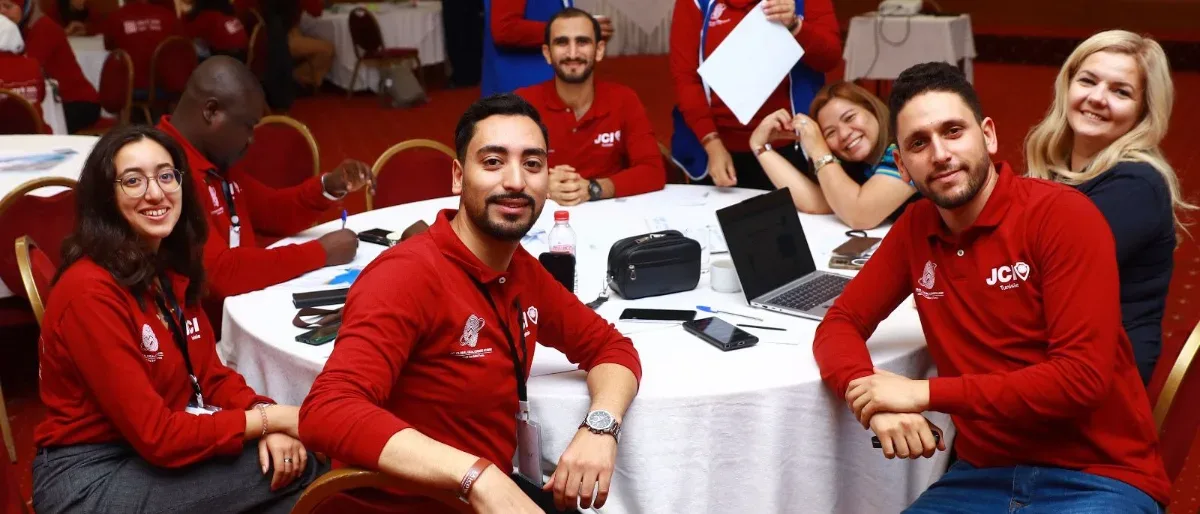
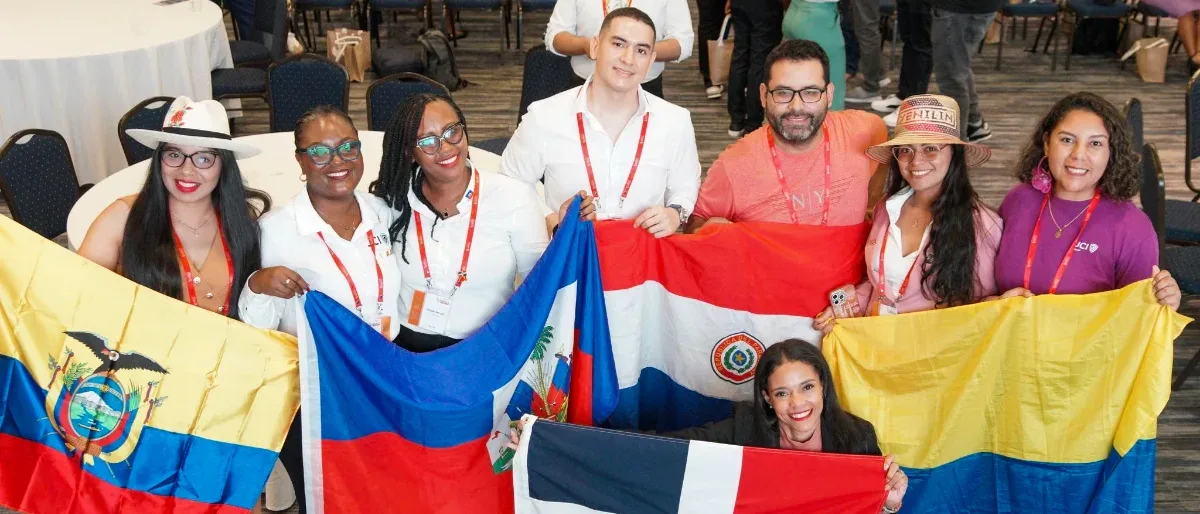
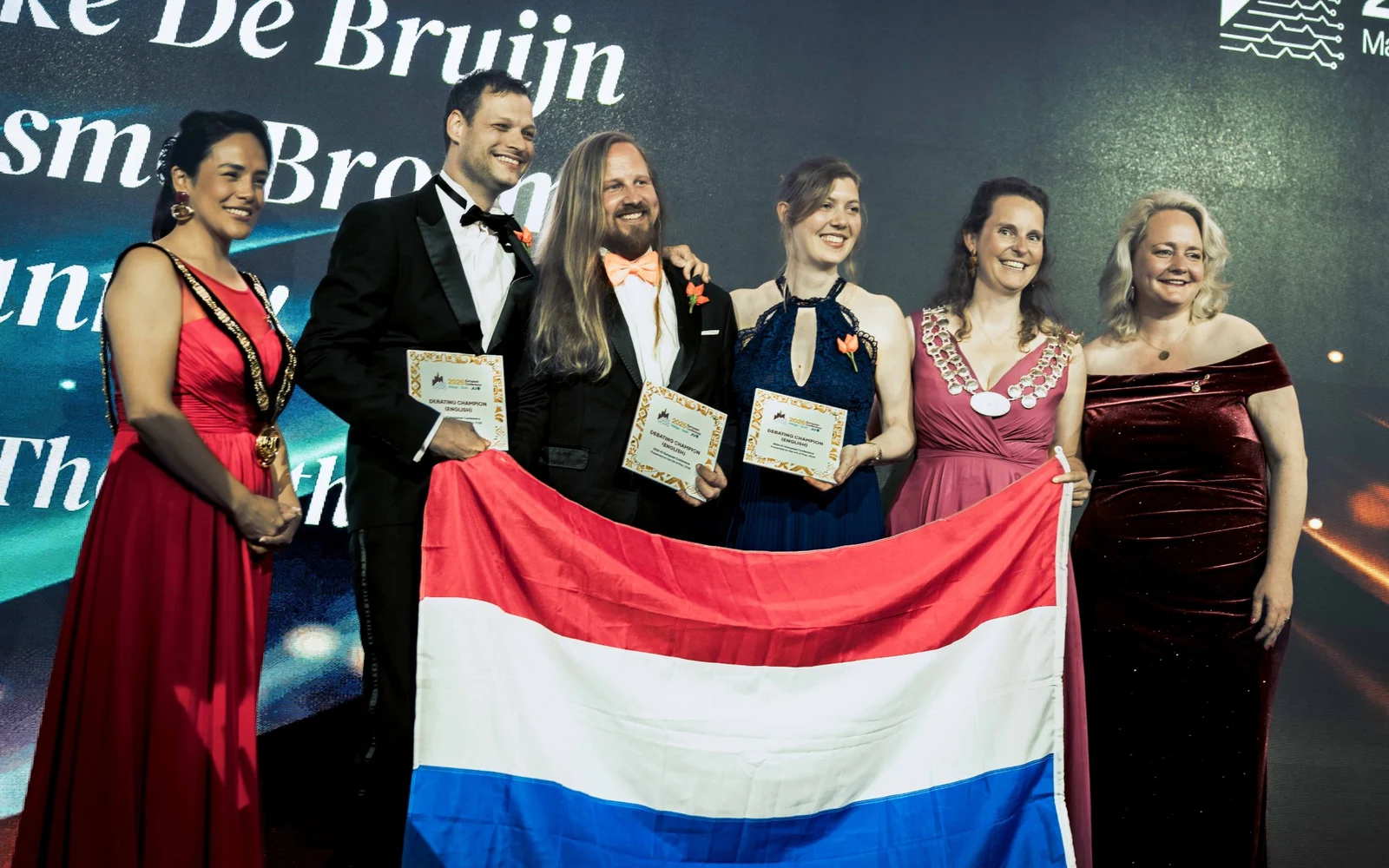
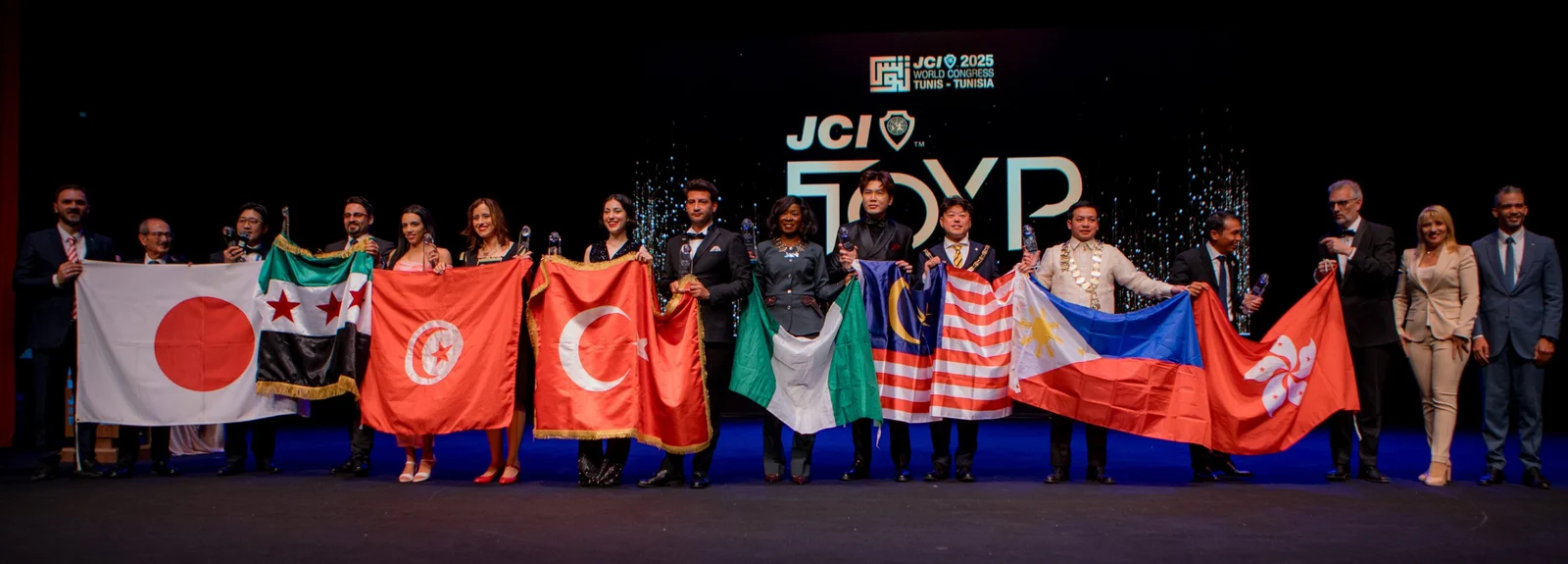
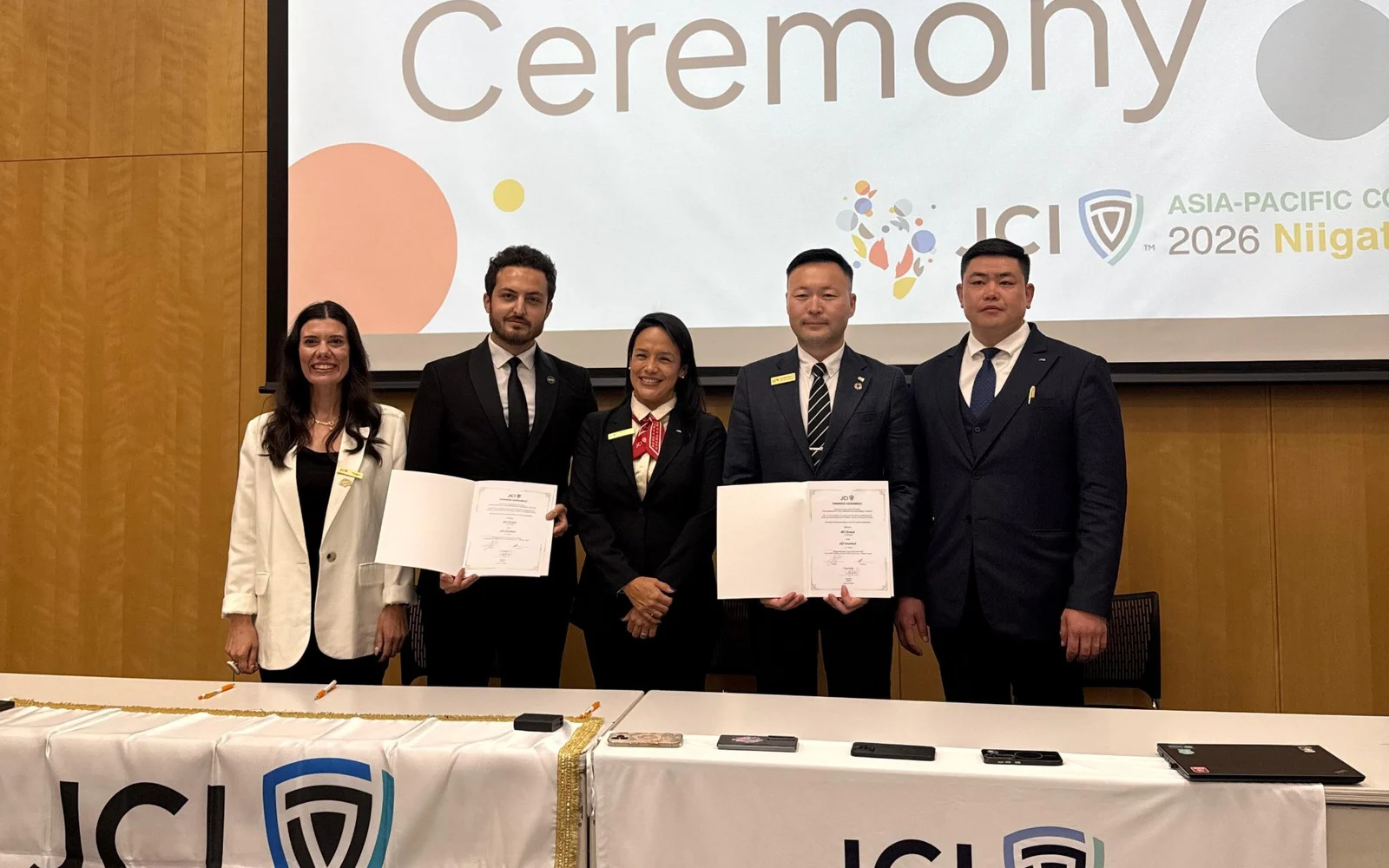
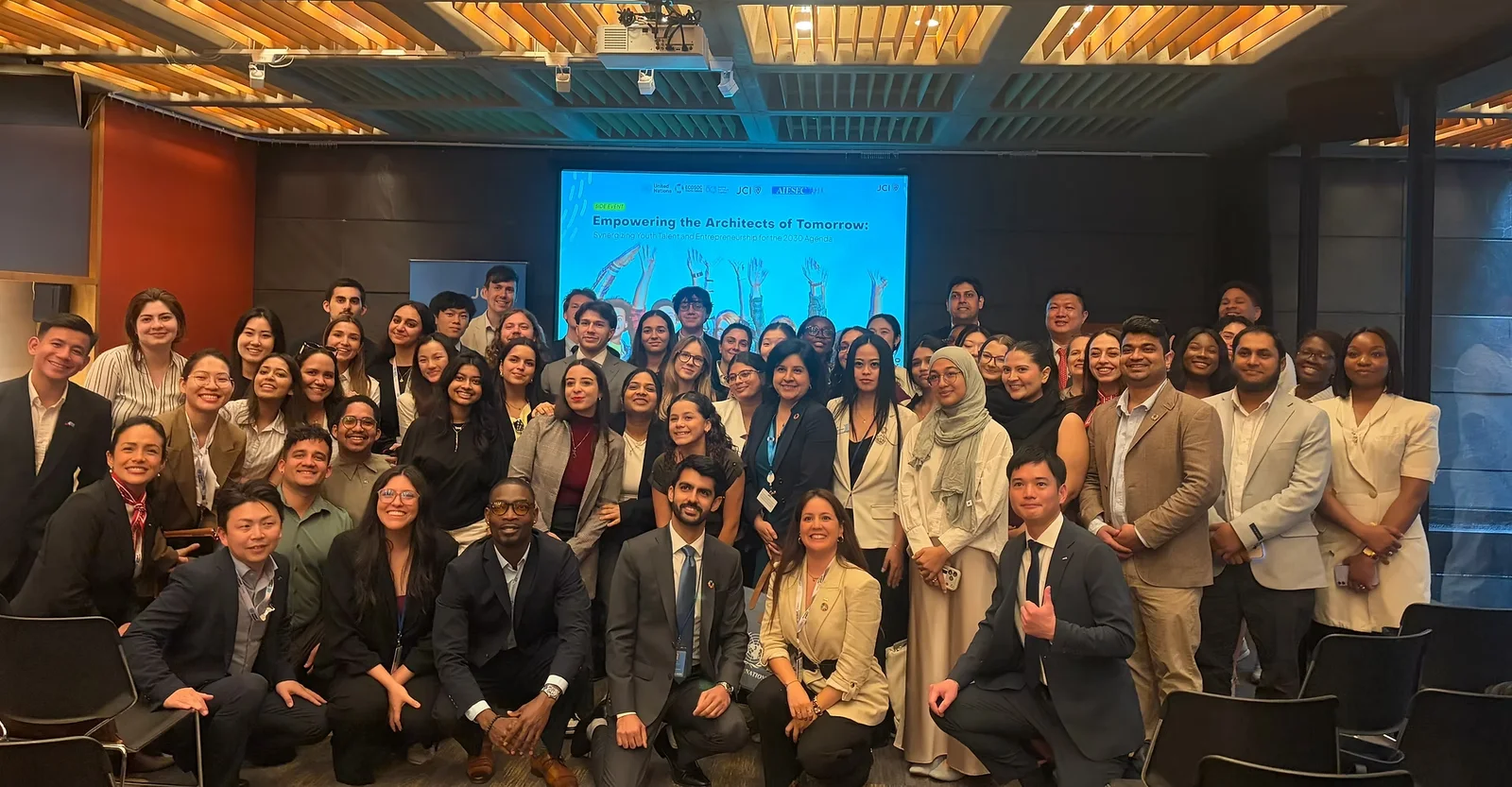
The 2025 JCI World Congress in Tunis, Tunisia, made a significant
impact in leadership and professional development, drawing 2,732
participants from 94 National Organizations.
The congress featured a range of interactive modules and specialized
workshops, where experts led sessions on important modern skills.
01
Training programme
Interactive modules and specialized workshops
Members learned hands-on, people-focused ways to tackle complex
chapter and community challenges using LEGO® SERIOUS PLAY® (led by
Kenneth Yu) and Design Thinking (by Maroua Beddadi).
LEGO® SERIOUS PLAY®
Kenneth Yu
Design Thinking
Maroua Beddadi
The session “Steps for a Better Tomorrow: Managing SDG Projects”
(led by Anirudh Sistla and Edinson Fonseca) equipped participants
with practical tools to design measurable and impactful community
projects. Through data-driven planning and the JCI Action Framework,
participants learned how to develop initiatives aligned with the
Sustainable Development Goals (SDGs) and create sustainable impact
in their communities.
Steps for a Better Tomorrow: Managing SDG Projects
Anirudh Sistla and Edinson Fonseca
The “Ban Ki-moon Global Citizenship Training” deepened participants’
understanding of global citizenship, cultural diversity, and shared
global challenges, while strengthening their skills in empathy and
cross-cultural dialogue. The session encouraged participants to
engage with different perspectives and translate global awareness
into responsible and sustainable action within their communities.
The session "From Idea to Investment: Navigating the Angel Finance
Ecosystem" (led by WBAF expert Baybar Altuntas) explained how to
turn ideas into investments. Another session, "Lead Your Financial
with GPT" (by Bolor Bayarsaikhan), gave participants a chance to
create mobile-ready Financial Advisor GPT tools.
From Idea to Investment: Navigating the Angel Finance Ecosystem
Baybar Altuntas
Lead Your Financial with GPT
Bolor Bayarsaikhan
Programs such as Brain-Smart Leadership: The Neuro Edge (by
Ibukunoluwa Otesile), Effective Communication (by Gleendo
Dasmarinas), Effective Leadership (Japanese Module) (by Hisayuki
Kamon), Innover avec peu (by Abdoul Aziz Issoufou Tiémogo),
Innovative Personal Branding in the Digital World (by Lucy Yihong
Jiang), and Your Leadership, Your Way: The Power of Authenticity (by
Carolin Hochmuth) offered valuable insights into neuroscience,
emotional intelligence, personal branding, and authentic leadership.
Brain-Smart Leadership: The Neuro Edge
Ibukunoluwa Otesile
Effective Communication
Gleendo Dasmarinas
Effective Leadership (Japanese Module)
Hisayuki Kamon
Innover avec peu
Abdoul Aziz Issoufou Tiémogo
Innovative Personal Branding in the Digital World
Lucy Yihong Jiang
Your Leadership, Your Way: The Power of Authenticity
Carolin Hochmuth
This interactive session led by 2025 AIESEC President Arfan Zazar,
explored what it meant to be a next-generation leader in an
increasingly uncertain world.. Through reflection, practical
insights, and discussion, participants examined their leadership
journeys, learned how antifragility could help them grow through
adversity, and considered how to approach calculated risks with
courage. The session encouraged young leaders to embrace
uncertainty, learn from failure, and take meaningful action.
Next Gen Leadership
Arfan Zazar
The Business Summit, powered by BNI Japan, brought together bold
entrepreneurs and forward-thinking business leaders at the 2025 JCI
World Congress in Tunis to explore what it took to grow and scale in
an interconnected world. The session was led by Swati Bansal,
Founder of Start Seekhna. Through thought-provoking discussions and
real-life success stories, the session highlighted global
opportunities, demonstrated the value of international expansion,
and addressed common barriers to scaling globally. Participants
gained fresh insights into the leadership mindset behind global
success and took part in an interactive activity that helped turn
ideas into action.
Business Summit, powered by BNI Japan
Swati Bansal
02
Advanced Trainer Pathways
Scaling Multiplied Impact
To support lasting community change, the congress focused on
developing top trainers who can multiply their impact.
CAT and CNT
The Certified Area Trainer (CAT) and Certified National Trainer
(CNT) Programs offered strong mentorship for members dedicated to
regional and national leadership training.
37
There are 37 more potential certified trainers, which expands
JCI's global training capacity and helps its leadership programs
reach more countries.
Partnerships
We built key international partnerships that make JCI's global
support for youth empowerment even stronger.
A Legacy of Continuous Growth
“2025 JCI World
Congress achieved its mission by bringing together a record number
of participants, reflecting on its operations, and making
proactive improvements. As a result, young leaders now have the
vision, tools, and networks they need to help build a better
future.”
International Cooperation and JCI Twinning
2026 Area Conferences
2026 Area Conferences
Conference of America: Fostering Regional Solidarity
Held in Antigua and Barbuda, West Indies, from May 13–16, 2026, the
JCI Conference of America brought together young leaders from across
the region for a program focused on leadership development,
entrepreneurship, communication, and regional collaboration.
Delegates participated in multiple Skills Development Sessions, the
National Presidents Workshop, and the First Timers Orientation,
while aspiring entrepreneurs presented their business ideas in the
Creative Young Entrepreneur competition. The Public Speaking and
English and Spanish Debating competitions provided platforms for
participants to strengthen their communication, critical thinking,
and argumentation skills. The Tradeshow created opportunities to
showcase initiatives and foster connections, while the National
Night and Global Village celebrated the region’s cultural diversity
and strengthened relationships among members.
The Conference also advanced JCI’s organizational priorities through
Conference Assemblies I and II, Local Officer and JCI President’s
Sessions, and preparation for the 2026–2030 JCI Strategic Plan. The
Twinning Ceremony reinforced international partnerships and
cooperation among JCI organizations. A key milestone was the full
implementation of the Brella app, building on its introduction at
the 2025 World Congress and achieving growing adoption among
conference attendees to improve access to event information and
facilitate networking. By combining practical skills development,
competitive learning, cultural exchange, and strategic planning, the
Conference equipped delegates with new capabilities, stronger
regional connections, and opportunities to translate shared
experiences into initiatives that benefit their organizations and
societies.
The 2026 JCI Conference of America (COA) proved that impactful
gatherings are measured less by attendance numbers and more by the
lasting connections formed between members. Participant feedback
paints a vivid picture of a region defined by shared cultural
discovery, leadership renewal, and an unwavering commitment to
honesty in organizational operations.
Global Exposure and Broadening Perspectives
For many delegates, particularly first-time international travelers,
the event provided a vital introduction to JCI's expansive reach.
“It gave me a deeper understanding of JCI. People I had only seen
on social media... really confirmed for me that JCI is a place
where social status doesn’t matter; we are all brothers and
sisters in spirit.”
“Me permitió conocer la idiosincrasia de la JCI en West Indies y
conocer Antigua que de otra manera no me hubiese interesado en
visitar.” (“It allowed me to experience the idiosyncrasies of JCI
in the West Indies and discover Antigua, which otherwise I
wouldn't have been interested in visiting.”)
Delegates embraced cultural exchanges, practicing English and
Spanish, exploring new traditions, and realizing that despite
regional differences, a shared JCI spirit unites them all.
Cultivating Strategic Ties and Enduring Bonds
Interactions in America went beyond basic networking, serving as a
springboard for professional partnerships and mentorship. The
conference provided a supportive environment for members to build
their social confidence and professional networks simultaneously.
“New friendships. New ideas and perspectives. New strategy. It
gave me a sense of what kind of connections JCI can provide.”
“Logre conectar con differentes profesionales e hice una gran red
de contacto, por igual logre alinear differentes acciones a nivel
nacional y local.” (“I managed to connect with different
professionals and built a great network of contacts; likewise, I
aligned different actions at the national and local levels.”)
For many shy or introverted members, the welcoming environment
provided a safe space to break out of their shells, build
confidence, and forge bonds that will last a lifetime.
Purposeful Evolution and Local Impact
The experience revitalized members' dedication to service,
encouraging a shift toward intentional leadership. Participants
gained the tools to address local organizational challenges and
return with actionable strategies for their chapters.
“This conference pushed me in three ways... It made me more
intentional about leadership, gave me permission to be honest
about the hard parts (like burnout and conflict), and reconnected
me to the ‘why.’”
Members noted feeling rejuvenated and less afraid to name what
wasn't working in their Local Organizations, returning home equipped
with actionable insights to design better member experiences, refine
their goals, and inspire their home chapters.
Conference of America showed that regional solidarity grows from
cultural discovery and thoughtful leadership. By bringing together
personal authenticity and organizational honesty, the event helped
JCI members across America build a unique identity and inspired them
to lead with a shared vision for a more connected and purposeful
future.
2026 Area Conferences
AMEC Insights: Regional Solidarity and Skill Mastery
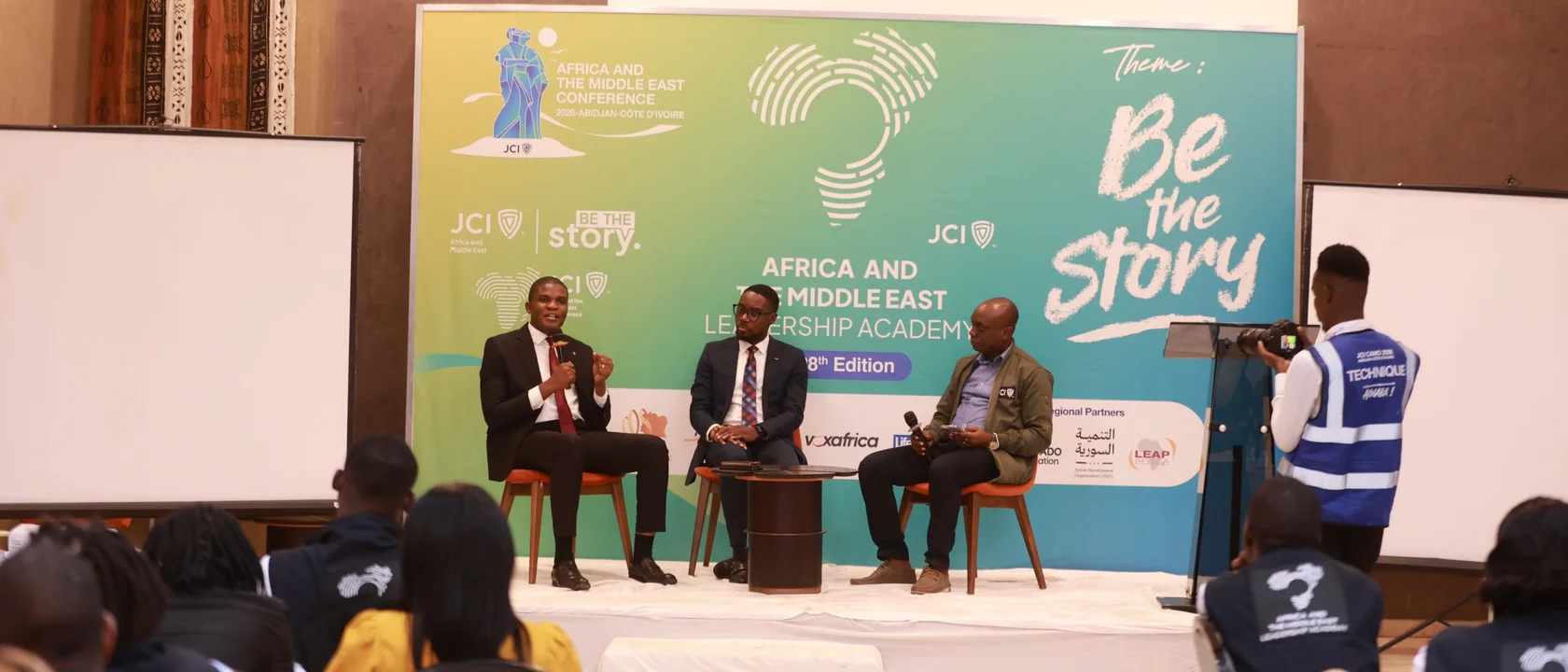
The 2026 JCI Africa and the Middle East Conference, held in Abidjan,
Côte d’Ivoire, brought together more than 500 delegates from over 40
countries, creating a vibrant platform for leadership development,
networking, collaboration, and cross-cultural exchange. The
conference featured numerous skills development sessions designed to
equip young leaders with practical knowledge, strengthen their
leadership capabilities, and enhance their ability to create
positive change in their communities. A key highlight was the
Leadership Academy, which welcomed 72 delegates from over 14
countries, for an intensive learning experience focused on
developing leadership competencies, fostering personal growth, and
preparing participants to take on greater responsibilities within
JCI and beyond.
Beyond leadership training, the conference featured innovative
programs that promoted regional integration, organizational growth,
and strategic partnerships. The Regional Partnership Summit provided
opportunities for stakeholders to explore collaborations and
strengthen relationships across Africa and the Middle East. The
Local Organization Twinning Program encouraged JCI organizations
across the region to establish lasting partnerships, exchange best
practices, and develop joint initiatives with the potential for
sustainable community impact. Through these activities and many
other networking and engagement opportunities, the conference
reinforced JCI’s commitment to empowering young people to create
positive change while building a stronger, more connected, and
collaborative network of young leaders across Africa and the Middle
East.
The 2026 JCI Africa and the Middle East Conference (AMEC) went
beyond the usual conference experience, serving as a strong center
for professional growth and bringing members from across the
continent together. Looking at the feedback from our delegates, it’s
clear that members are building their training skills and deepening
the connections that make this region unique.
Cultural Synergy and Continental Integration
Participants viewed AMEC as a microcosm of continental unity,
allowing them to traverse diverse traditions and languages. The
gathering reinforced a sense of shared identity across Africa and
the Middle East.
“I understand better that JCI is a cultural village and aims to
network on a global scale.”
“Africa is the greatest and most vibrant continent... I learned a
lot about differences between nations based on culture and the
importance of learning different languages.”
Participants frequently noted how the event opened their minds to
new perspectives, fostering a deep sense of brotherhood (le sens de
la fraternité) and international understanding.
Empowerment Through Specialized Training
The focus on technical capacity, particularly through CNT programs,
facilitated significant professional advancement. Members
highlighted how these specialized pathways clarified their career
trajectories and improved their facilitation abilities.
“Through the CNT program, I enhanced my training and facilitation
skills while gaining valuable insights that I can apply within my
Local Organization and community.”
“I have now identified my path. I want to be a Trainer.”
Delegates emphasized acquiring practical, transferable skills that
elevated their performance both within JCI life and in their
external professional careers.
Intercontinental Collaboration and Global Scaling
Strategic networking sessions encouraged members to think beyond
local borders. By learning from distant counterparts, delegates
discovered new methodologies for project management and
international cooperation.
“Elle a complètement transformé ma vision des projets que nous
réalisons dans mon pays. J'ai réalisé que nous avons besoin
d'avantage de réseautage avec des pays qui sont très éloigné de
nous pour réellement apprendre d'eux et vice versa.” (“It
completely transformed my vision of the projects we carry out in
my country. I realized we need more networking with countries far
away from us to truly learn from them and vice versa.”)
Members reported gaining clarity on their priorities, overcoming
procrastination, rebuilding self-confidence, and committing to lead
by example to make their Local Organizations shine globally.
Self-Discovery and Motivational Rebirth
The conference helped people achieve personal breakthroughs by
clarifying their goals, boosting their confidence, and allowing them
to connect in person with others they had only met online.
“This conference had a profound impact on me, both personally and
professionally... I returned home motivated, empowered, and ready
to contribute even more to the development of future leaders.”
AMEC 2026’s legacy comes from combining specialized training, like
the CNT program, with a strong sense of unity across the continent.
This mix of skills and shared purpose helps young leaders go back to
their communities in Africa and the Middle East feeling more
confident, capable, and ready to make a difference together.
2026 Area Conferences
European Conference: Business Growth and Cross-Border Unity
The 2026 JCI European Conference welcomed members from Europe and
around the world to Málaga for four days of leadership training,
competitions, and networking. The event took place at the NH Hotel
and FYCMA (Palacio de Ferias y Congresos de Málaga) from 29 April to
2 May.
The conference opened with the National Presidents Meeting and the
Q2 Townhall with JCI Europe, and concluded with the Conference
Assembly. The JCI Senate held its National Senate Presidents Meeting
and General Assembly. The JCI President’s Session on Building the
JCI Membership Journey and a dedicated Strategy Session reinforced
global priorities.
National and Area Trainer Certifications ran over three days ahead
of the official opening, strengthening the region’s trainer
pipeline. More than ten skills development sessions, delivered in
English and French, covered topics such as persuasive speaking,
imposter syndrome, AI-powered project management, decision-making
under pressure, multigenerational teams and SDG project management.
Team Europe delivered Candidates Training, Deputy Training and the
Local Officers Series on governance and member retention.
Members competed in the Creative Young Entrepreneur Award, Public
Speaking, and Debating in English, French and German. The Twinning
Ceremony strengthened ties between National Organizations, and a
First Timers Orientation welcomed new delegates.
The conference featured sessions with the Ban Ki-moon Foundation,
the UN Youth Office, the International Chamber of Commerce (ICC),
AIESEC, RELX, PMI, SIXT and CLIC, alongside a Partnership Summit and
a three-day Partners Networking Hub.
The Female Leadership Empowerment Forum and the ElevateHer
leadership gathering highlighted women’s leadership, while sessions
on sustainable leadership, JCI in Business and the JCI Action
Framework 2.0 connected members to the organization’s impact agenda.
The Opening Ceremony, Orange Night, European Village, Awards
Ceremony, Closing Ceremony and Gala Dinner celebrated European
achievements and cultural exchange.
The JCI European Conference brought together personal leadership
growth and real business opportunities. Attendees said the event was
transformative, helping them build international connections and
giving them the confidence to make a bigger impact at home and
abroad.
International Citizenship and Zone Expansion
In Málaga, delegates stepped out of their comfort zones and
connected with people from different European cultures. This
experience helped everyone feel more responsible and part of an
international community.
"The conference had a positive impact on me because it gave me a
much broader view of JCI. It showed me how international, active
and diverse the organisation really is. I also returned with new
motivation, new contacts and a better understanding of how much
can be achieved when members from different countries share
ideas..."
"Ce type de conférence nous fait grandir personnellement et nous
fait sortir de notre zone de confort ; intellectuellement,
socialement et au niveau des langues également." ("This type of
conference makes us grow personally and pushes us out of our
comfort zone; intellectually, socially, and in terms of languages
as well.")
Members highlighted how stepping into international spaces empowered
them to overcome language hesitations, embrace cultural diversity,
and step outside their comfort zones.
Tangible Ventures and Professional Partnerships
Professional networking led to concrete outcomes, including real
estate investments and chapter twinning agreements. The conference
acted as a commercial marketplace where members could align local
initiatives with global resources.
"I built a significant number of new connections during the
conference. Some of these contacts may potentially invest by
purchasing a commercial unit in our new project in my city. I also
met someone with whom we may establish a future collaboration by
investing in construction projects in their region."
"More visibility, knowledge and awareness. Confidence in our
ongoing projects. Networking. New business opportunities &
ideas for my local JCI chapter."
Whether launching new business ventures, expanding regional real
estate ventures, or forming local chapter partnerships (such as new
twinning partners for JCI Bruges), attendees returned home with
actionable professional capital.
Mastery of Self and Leadership Confidence
The Málaga gathering provided the necessary tools for emerging
leaders to overcome professional anxieties. Attendees returned home
with a stronger sense of self-worth and a clearer vision for scaling
their local impact.
"It gave me the confidence I needed to do the work I didn't have
enough confidence to start by giving me the right tools."
"The most important impact was the ability to see my own skills
and future possibilities more clearly, it gave me a healthy dose
of better self-esteem."
"Everyone pushing on my 'imposter syndrome' button, I really have
to work on it now!"
Delegates reported returning to their home chapters with renewed
energy, actionable strategies for leading volunteer teams, and a
clearer vision to scale local initiatives to national and
international levels.
Málaga 2026 showed that when teams work together and people feel
confident, businesses can grow and professionals gain real value.
The European Conference helped delegates focus on smart investments
and inspired new leaders to achieve real international success.
2026 Area Conferences
ASPAC Experience: Asia-Pacific Connections and Transformation
The 2026 JCI Asia-Pacific Conference (ASPAC) was held from June 11
to 14 in Niigata City, Japan. Centered on the theme "Be the Change –
For a Brighter Future," the event gathers young leaders and
entrepreneurs from across the region for leadership meetings,
keynote speeches, skills development sessions, and cultural
exchanges, including National Nights and award ceremonies.
Inspired by Niigata's native Nishikigoi (ornamental koi carp), a
symbol of transformation and persistence, the conference encourages
participants to embrace growth, overcome challenges, and make a
positive impact. The conference offered a comprehensive program of
professional, competitive, and cultural sessions to promote
international collaboration and leadership. The Keynote &
Educational Sessions addressed key regional and global issues,
featuring topics such as sustainability, as well as workshops and
leadership training modules. Competitions & Contests showcased
member talents through events such as thel JCI speech and debate
contests. Leadership Meetings brought together national JCI leaders
and delegates to coordinate regional strategies, officer
development, and community impact initiatives. Cultural &
Networking Events complemented the formal proceedings with immersive
regional experiences, including the Commemorative Tea Ceremony,
National Nights, official award ceremonies, and trade shows that
celebrate local crafts and international partnerships.
The 2026 ASPAC Conference helped members appreciate the wider impact
of JCI around the world. Through personal stories, it became clear
that the event offered more than just inspiration. The connections
made across borders encouraged a lasting commitment to making a
positive difference in local communities.
Global Vision and Regional Integration
ASPAC opened the door to JCI’s international reach and encouraged
delegates to think beyond their local chapters. Members said they
gained a better sense of how different national organizations work
together to reach global goals.
“It brought project partners together from near and far to build a
closer bond on partnership levels.”
“It made me realize the impact JCI has globally... I gained
different new perspectives on JCI, and how all NOMs and LOMs
connect to maintain these bonds.”
Twinning, Tradition, and Lifelong Camaraderie
Cultural exchanges with host chapters helped our institution grow.
Signing new twinning agreements and business partnerships showed the
real benefits of these regional gatherings.
“ASPAC reminded me why JCI is such a valuable organization... I
was also honored that JCI Bandung had the opportunity to
contribute to the Global Peace Summit with our Sister Chapter (JCI
Hamamatsu), making this conference even more meaningful for me."
"The most meaningful part for me was reconnecting with my twinning
sisters and the members I worked with on the Global Youth
Ambassador project 2025. It was also wonderful to see old friends
again and to experience the Asia-Pacific Senators’ program for the
first time."
One member highlighted concrete milestones, including signing two
formal twinning agreements, establishing new business opportunities,
and deepening collaborations with sister chapters across borders.
It also included special moments: "Introduce JCI event to my
children and even attend a session with my 3-year-old son!"
Inspiring Personal Change and Communicative Power
The conference helped people build social confidence and improve
their communication skills. Participants took part in valuable
discussions and focused sessions that inspired them to bring new
ideas back to their communities.
"Although we came from different countries and backgrounds, we
shared the same passion for communication and personal growth...
Seeing so many passionate young leaders has motivated me to
continue improving as a speaker..."
"It inspired me to grow as a leader and communicator. It boosted
my confidence..."
“The conference had a truly transformative impact on me... I left
feeling incredibly inspired and motivated to implement these new
ideas and drive positive change in my own community.”
"Exchanging ideas, learning about different cultures, and sharing
best practices reminded me of the power of collaboration... This
conference reinforced my commitment to creating positive change in
my Local Organization and community..."
ASPAC 2026 succeeded by balancing leadership inspiration with
meaningful cultural exchanges between sister chapters. These lasting
global connections, built on camaraderie and shared traditions,
drive local transformation and demonstrate that bonds formed in the
Asia-Pacific region endure as strongly as the changes they inspire.
2026 Area Conferences
Voices of the Regional Area Conferences
“
I've been a member for 9 years now. And this is my 5th physical
International Conference. Everytime is a new experience, a new
connection, a new lesson in personal growth. I think everyone
should participate at one of these events at least once in their
lifetime as the energy, vibes and content is unmatched. Each
experience is going to be personal to you but it's so worth it and
that feeling of having a mindblowing moment is crazy. I didn't
think an idea like that would be worth something, I didn't think I
would get to make direct contact with a person of that background
or that level, I didn't know what I didn't know but now I do and
my world is expanded. Trust me, you'll ALWAYS experience something
you'll never forget at these JCI conferences. Take a chance on
yourself and grow.
Anjeanee Mathew, JCI Dutch Caribbean
“
Before this Conference I was afraid in my heart of hearts that
maybe I was not a good fit for the World and I could only work in
my own country, but after this event I found inspiration in so
many young leaders like me that are not afraid to bleed their
hearts internationally, they are not afraid of putting themselves
on the market and look for better opportunities for them and their
families. JCI wants US to keep growing, to become international
citizens, to not have barriers of any kind and to achieve all we
can achieve, and I'll just do that now. Thanks JCI for giving me
that soft push I needed in the form of so many new friends,
experiences and moments I'll cherish until the last of my breaths.
Gracias totales.
Roberto Emilio Muñoz Rodriguez, JCI Ecuador
“
Attending this conference was truly an unforgettable experience.
What I enjoyed the most was the opportunity to connect with
passionate young leaders from different countries, exchange ideas,
and learn from diverse cultures and experiences. The trainings,
networking sessions, and meaningful conversations reminded me of
the real power of in developing leaders and creating positive
change around the world. The conference challenged me to think
bigger, lead with more purpose, and bring fresh ideas back to my
Local Organization and community. Beyond the sessions, the
friendships, collaborations, and shared moments with fellow
delegates made the experience even more special. I return home
feeling inspired, motivated, and even more committed to making an
impact through leadership and service.
Romario Sahai, JCI Suriname
“
Attending my first JCI Area Conference was an unforgettable
experience. I felt deeply grateful to be part of an organization
that constantly creates opportunities for growth, learning, and
meaningful impact. What I enjoyed most was the chance to meet
amazing people from different countries and cultures, exchange
ideas, and build genuine friendships beyond borders. This
conference reminded me that JCI is more than a network it is a
family of committed young leaders working together to create
positive change in society. Being recognized as Best New Member of
JCI Africa and the Middle East made this experience even more
special and motivating. I would truly encourage every young person
who wants to grow, serve, and connect with inspiring people to
join JCI.
Fatou Loum, JCI Senegal
“
Honestly, attending the JCI conference completely refueled my
'why.' When you're caught up in the daily grind of work and
managing projects, it’s easy to focus just on the logistics. But
being in a room filled with young leaders from different chapters
shifted everything back to the actual impact. The best part was
definitely the unscripted conversations over coffee. Swapping real
stories, sharing strategies, and realizing we face the exact same
challenges created this instant, genuine connection. It really
challenged me to think about sustainable leadership—not just
finishing a project, but leaving something lasting behind.If
you're looking for a place where your professional skills meet
real-world purpose, JCI is it. You'll stretch your boundaries,
find your community, and grow in ways you didn't expect.
You Chinkheng, JCI Cambodia
“
Attending ASPAC Japan was an unforgettable experience that
inspired me both personally and as a JCI leader. Beyond the
sessions, connecting with JCI members from across the Asia-Pacific
region was truly meaningful. Exchanging ideas, learning about
different cultures, and sharing best practices reminded me of the
power of collaboration and the global impact of JCI. I returned
home with fresh perspectives, renewed motivation, and valuable
friendships. This conference reinforced my commitment to creating
positive change in my Local Organization and community, and I
highly encourage every JCI member to experience an ASPAC
Conference at least once.
Ma. Christine Torralba, JCI Philippines
“
The JCI European Conference in Málaga was a truly energizing and
inspiring experience. As a global changemaker, I was inspired by
the strong spirit of international collaboration. The connections,
conversations, and openness made it easy to think bigger and act
beyond borders. All of this was realized by an outstanding COC
Team that created the space for meaningful exchange and lasting
impressions.
Marlen Wehner, JCI Germany
“
Attending EC was so eye-opening for me as a JCI member to see the
true global scale and impact of the organization. Meeting people
from across our region who have different working styles,
organizational structures, languages, and challenges — and then
finding common ground and passion to make a difference in the
world — was so special.
Abigail Noonan, JCI United Kingdom
Individual Development
2026 Area Conferences Training Highlights
Training
Empowering America: Training & Development Excellence at COA
2026 JCI Conference of America Saint John's, Antigua and
Barbuda
The 2026 JCI Conference of America (COA) in Saint John's, Antigua
and Barbuda, gathered young leaders and changemakers from all parts
of the Western Hemisphere for a vibrant combination of networking,
governance, and leadership training. Focusing on providing members
with practical tools to promote both their community and
professional development, the event had 339 participants from 38
National Organizations.
The conference had an engaging educational programme organized by
experienced facilitators, consisting of ten skill-building sessions
(six of which were in English and four in Spanish) and four
committee meetings as well. It furthermore contributed to excellence
in regional training by certifying 16 new Certified National
Trainers (CNTs) and 5 Area National Trainers (ANTs) via its
professional development programmes.
01
Training programme
Curriculum Highlights & Featured Training Topics
The 2026 program connects strategy with real-world action, supporting
members as they develop skills in sustainable project planning,
technology, personal leadership, and organizational management.
Workshops on sustainable community action included Steps for a
Better Tomorrow: Managing SDG Projects, led by Leycia Samuels
(Deputy Chairperson, America - 2026 JCI SDC), which showed members
how to use the JCI Action Framework and Theory of Change for
data-driven projects. Marlen Wehner (Global Chairperson, 2026 JCI
SDC) expanded global civic awareness with her module on Global
Citizenship for Young Leaders.
Steps for a Better Tomorrow: Managing SDG Projects
Leycia Samuels
Global Citizenship for Young Leaders
Marlen Wehner
The curriculum focused on digital transformation and strong
decision-making to help regional leaders get ready for the future.
Khaleid Holder (Past National President, JCI West Indies) led a
session on using artificial intelligence in project management.
Stuart Knott (SDC Chairperson - America) introduced the basics of AI
prompting, showing members how to use AI for research and
communication. Esunge Ariunbold, JCI Skills Development Manager,
demonstrated JCI's updated Learning Management System (LMS).
Artificial intelligence in project management
Khaleid Holder
The basics of AI prompting
Stuart Knott
JCI's updated Learning Management System (LMS)
Esunge Ariunbold
The training program finished with sessions focused on personal
excellence and team dynamics. Marcela Chinchilla, Past National
President of JCI Honduras, offered tools for handling emotions
during stressful times. Melina Espinal, National Vice President of
JCI Dominican Republic, talked about leading volunteer teams by
using influence instead of authority. Jill De Sena, 2026 JCI Vice
President, closed the program by urging leaders to build
purpose-driven visibility in De invisible a influyente: construir
visibilidad con propósito.
Handling emotions during stressful times
Marcela Chinchilla
Leading volunteer teams through influence
Melina Espinal
De invisible a influyente: construir visibilidad con propósito
Jill De Sena
02
Led by
The facilitators
Sustainable community action
Leycia Samuels
Deputy Chairperson, America - 2026 JCI SDC
Sustainable community action
Marlen Wehner
Global Chairperson, 2026 JCI SDC
Digital transformation and decision-making
Khaleid Holder
Past National President, JCI West Indies
Digital transformation and decision-making
Stuart Knott
SDC Chairperson - America
Digital transformation and decision-making
Esunge Ariunbold
JCI Skills Development Manager
Personal excellence and team dynamics
Marcela Chinchilla
Past National President, JCI Honduras
Personal excellence and team dynamics
Melina Espinal
National Vice President, JCI Dominican Republic
Personal excellence and team dynamics
Jill De Sena
2026 JCI Vice President
“With these
specialized tracks and advanced training in the CAT and CNT
programs, the 2026 Conference of America helped a new generation
of regional leaders gain practical skills to turn shared visions
into real results in their communities.”
Training
Catalyzing Regional Growth: Training & Development Excellence at
the Africa and the Middle East Conference
Participants and leaders
More than 541
National Organizations
41
Training sessions
8
Certified National Trainers
37 French, 9 English
Certified Area Trainers
15 French, 4 English
Overview
2026 JCI Africa and the Middle East Conference Abidjan, Côte
d’Ivoire
The 2026 JCI Africa and the Middle East Conference (AMEC) in
Abidjian, Cote D’Ivoire, welcomed more than 541 participants and
leaders from 41 National Organizations. The event aimed to turn
regional goals into real community impact with a lively bilingual
program.
The conference focused on active capacity building instead of
passive participation. It offered eight training sessions to develop
specific skills, with sessions held in English and French. Topics
included project management, sustainable development, artificial
intelligence, financial management, and peacebuilding.
01
Training programme
Curriculum Highlights & Featured Training Topics
The participants were given the opportunity to take practical steps
towards bringing about positive change in their communities. During
a session titled "Steps for a Better Tomorrow: Managing SDG
Projects", Mondher Louati (National Director, JCI Tunisia) and
Shiella Kampazanga (National Treasurer, JCI Zimbabwe) taught the JCI
Action Framework, looked at Theories of Change and used public data
to design solid grassroots projects. Marlen Wehner (Global
Chairperson, 2026 JCI SDC) and Carolin Hochmuth (Deputy Federal
President, National Board of JCI Germany) promoted a sense of global
citizenship and facilitated cross-cultural dialogue, enabling the
young leaders to deal with global issues with empathy and diplomacy.
Daniel Racz (Commissioner - Skills Development Commission)
,explained how AI can be used in project management, and Maroua
Beddadi (2020 National Vice President, JCI Tunisia) gave practical
training in the basics of AI prompting. The sessions allowed the
leaders to make use of artificial intelligence to assist with
communication and decision-making, without losing sight of human
leadership.
The program also aimed at enhancing economic resilience and at
promoting entrepreneurship. Abdoul Aziz Issoufou Tiémogo (JCI
Senator) conducted a practical session concerning financial
management for associations, and Coslin Degbey (Local President, JCI
Cotonou Étoile) gave a presentation entitled 'From Zero to
Entrepreneur: Key Steps to Launch Your Business'. In order to help
improve group organisation and emotional intelligence, Fares Ben
Souilah delivered 'The Heroes Journey: Emotional Intelligence &
Profiling'. Amadou Amadou Traoré (National Vice President, JCI Mali)
led a session on 'Building Peace and Managing Conflict', providing
the members with tools for mediation and for teamwork to aid in the
creation of stable and inclusive communities.
A major achievement of the conference was the expansion of certified
regional training. The Certified National Trainer (CNT) and
Certified Area Trainer (CAT) schemes increased local expertise and
led to 37 French-certified and 9 English-certified National
Trainers, together with 15 French-certified and 4 English-certified
Area Trainers. The growth in the number of accredited facilitators
will enable world-class leadership and technical education to
continue after the conference.
“The Africa and the
Middle East Conference helped a new generation of young leaders
gain the frameworks, networks, and technical skills needed to
drive sustainable, local transformation across the region.”
Training
Empowering European Changemakers: The Transformative Impact of the
2026 JCI European Conference
Participants
1,158
National Organizations
55
Skill development sessions
9 English, 2 French
Certified National Trainers
5
Area National Trainers
8
Overview
2026 JCI European Conference Málaga, Spain
The 2026 JCI European Conference in Malaga, Spain, assembled 1,158
participants from 55 National Organizations and played a key role in
driving regional change. By bringing together young leaders,
entrepreneurs, and changemakers, the event fostered a spirit of
collaboration centered on learning, good governance, and building
sustainable communities.
A strong curriculum was at the heart of the conference. Participants
could join nine skill development sessions in English and two in
French, as well as intensive programs for 5 Certified National
Trainers and 8 Area National Trainers. These sessions gave delegates
practical tools to address today’s leadership challenges.
01
Training programme
Curriculum Highlights & Featured Training Topics
Jean-François Pohle led a course where participants explored the JCI
Action Framework and Theory of Change models. This training helped
them connect their local projects to specific UN Sustainable
Development Goals using public data. At the same time, Marlen
Wehner’s session on Global Citizenship for Young Leaders promoted
cross-cultural empathy and increased awareness of global challenges,
helping participants feel more united in their purpose.
Saila Järvinen-Junttila and Essi Kemppainen led the AI-Powered
Project Management program, teaching JCI Leaders how to use
technology while still focusing on people. Carolin Hochmuth’s course
on Decision-Making Under Pressure and Ana Nikolova’s session on
Leading Multi-Generational Teams offered practical strategies for
managing complex situations and connecting across generations.
The conference also emphasized long-term vision and personal
resilience. In her workshop, Personal Strategy for the Next 5 to 10
Years, Jana Daniela encouraged professionals to use a 'portfolio
mode' approach, connecting their career growth with community
impact. Jean-François Pohle and Elisa Härtel led sessions for
high-potential leaders facing internal challenges, helping them
overcome fear, self-doubt, and imposter syndrome in both French and
English. This support gave new changemakers more confidence and
clarity as leaders.
Participants also expanded their networks by joining Sara Franzone’s
hands-on networking masterclass, Créer Et Développer Son Réseau
Relationnel. They strengthened their communication and influence
skills in Pierre Yimbog’s Speak To Influence: Master Confident
Delivery And Persuasive Debate.
“Overall, the 2026
JCI European Conference provided much more than networking
opportunities. With advanced trainer certifications, new digital
tools, and expert-led skills sessions, it equipped a new
generation of European leaders with the practical skills and
resilience needed to turn shared visions into real, lasting
results in their communities.”
Training
Igniting the Region: Training & Skills Excellence at the 2026 JCI
Asia-Pacific Conference
Delegates
8,133
National Organizations
52
Skill development sessions
11
Certified National Trainers
34
Area National Trainers
19
Overview
2026 JCI Asia-Pacific Conference Niigata, Japan
The 2026 JCI Asia-Pacific Conference in Niigata, Japan, welcomed
8,133 delegates from 52 National Organizations. By bringing together
young leaders, entrepreneurs, and changemakers, the event offered a
space for collaboration on strategic governance, sustainable
community development, and educational growth that makes a real
difference.
A big highlight of the event was its curriculum, which included 11
skill development sessions and training for 34 Certified National
Trainers and 19 Area National Trainers. These programs gave
delegates practical tools to tackle today’s leadership challenges.
The JCI Asia-Pacific Conference supported regional growth by uniting
young leaders, entrepreneurs, and emerging changemakers who want to
make a difference. The training program linked big-picture strategy
with practical steps delegates could use.
01
Training programme
Curriculum Highlights & Featured Training Topics
The training began with a focus on sustainable development and
global citizenship. Through Steps for a Better Tomorrow: Managing
SDG Projects, Claudia Chor guided participants in designing
community projects using the JCI Action Framework, Theory of Change,
and public data, concluding with one-minute project pitches.
Meanwhile, Emory White delivered Global Citizenship for Young
Leaders, encouraging participants to embrace cultural diversity,
understand global challenges, and strengthen cross-cultural
communication.
The conference also highlighted future-ready leadership and digital
skills. Zafir Shafiee introduced AI-powered project management,
demonstrating how artificial intelligence can improve
decision-making and project execution while keeping human leadership
central. Uelunzee Udaakhbayar provided practical AI prompting
techniques and safety guidelines to help participants use AI
effectively in their daily work. At the same time, Heaven
Penaflorida delivered Executive Presence, helping participants
strengthen their confidence, body language, and communication to
become more influential leaders. Grace Cheong delivered Leading
Generational Teams, helping participants understand how to
collaborate effectively across different generations and
cross-functional teams. The session highlighted the importance of
embracing diverse perspectives, bridging generational differences,
and strengthening communication to build more inclusive and
high-performing teams.
Leadership development continued with a focus on resilience and
teamwork. Marlen Wehner shared practical strategies for managing
stress, pressure, and burnout while maintaining personal
effectiveness. Wen Qi Soon facilitated Effective Teamwork,
introducing Tuckman and Lencioni's teamwork models through the
interactive Lost on Safari challenge, encouraging collaboration and
problem-solving.
The sessions also explored career development and people-centered
leadership. Rochele Borton introduced the concept of portfolio mode,
guiding participants in creating a 12-month plan that connects
professional growth with community impact. The conference also
featured two Japanese-language training sessions. Keita Ogino
delivered Move Hearts, Move the Organization, emphasizing how trust,
human connections, and strong relationships drive organizational
transformation. Meanwhile, Mariko Yamai facilitated Analysis-Driven
Leadership, encouraging participants to examine social challenges
more deeply and use analytical thinking to make informed decisions
and create meaningful change.
“The 2026 JCI ASPAC
Conference inspired a new generation of leaders by combining
exciting regional programs with practical frameworks and real
innovation, showing that meaningful change is possible.”
Individual Development
Discovering Future Leaders Through Debate and Public Speaking
Before she became a champion and stepped onto the stage, Eva Diouf
had to battle stage fright (le trac) within herself. It took a great
deal of discipline to overcome this problem. This personal
accomplishment also involved a major difficulty: learning how to
organize complex arguments rapidly, an ability which later became a
key element of her competitive advantage.
For Eva, public speaking and debate are much more than academic
exercises. They are strong tools for social change. "La
communication est le pouvoir et savoir communiquer est essentiel
pour avoir un impact sur le monde. La force d'une idée ne vaut pas
que par la capacité à l'exprimer. La puissance du verbe réside dans
l’expression et l’expression pousse à l’action,” she notes.
(Communication is power, and knowing how to communicate is essential
to having an impact on the world. The strength of an idea is not
determined solely by the ability to express it. The power of the
spoken word lies in expression, and expression drives action.)
Through her experience in JCI debate, she learned that you cannot
convince anyone unless you understand them first. When facing
high-pressure situations, Eva follows a simple three-step method for
leading and building agreement. First, she listens carefully, aware
that everyone has blind spots. She listens to truly understand, not
just to respond, which helps lower tensions and uncover what people
really need. Next, she focuses on building consensus, remembering
that the aim is not just to prove a point but to find the best
solution by combining different ideas. Finally, she remains calm and
focused, keeps discussions on track, makes sure everyone is heard,
and helps the team stay united around a common goal. Debate taught
her how to turn different opinions into a shared plan, which is
essential for leading diverse teams under pressure.
Advice for young professionals
For young professionals seeking to find their voice and make an
impact, Eva offers a powerful philosophy grounded in service
rather than ego:
“Parler pour
servir, pas pour briller à tout prix. La confiance en soi suit
l'impact. La plupart des jeunes veulent prendre la parole
alors que les leaders veulent résoudre des problèmes.”
(Speak to serve, not to shine at all costs. Self-confidence
follows impact. Most young people want to speak up, whereas
leaders want to solve problems.)
The journey to the podium began with a difficult internal shift,
overcoming deep-seated self-doubt. By consciously challenging the
voice that questioned his competence, Donte pushed past his initial
hesitations and embraced his potential on stage. This growth was
anchored by his dedication to technical precision, specifically in
learning how to organize his thoughts and communicate with absolute,
unwavering clarity.
For Donte, public speaking and debate serve as powerful catalysts
for real-world civic change. Expressing views clearly, conducting
rigorous research, and organizing opinions effectively are vital
tools for advancing socio-political movements. Furthermore, the
high-pressure environment of debate fundamentally enhanced his
ability to listen actively and distinguish between facts and
opinions. Under intense pressure, the experience forced him to slow
down and tune out the noise, teaching him how to listen exclusively
to pertinent information.
Advice for young professionals
For young professionals looking to find their voice and make an
impact, Donte offers a grounded, research-backed framework:
“Before you speak
on anything, see what others have said about it, both good and
bad, and root your voice in deep research, not just your own
understanding.”
Atia Thomas faced a demanding journey, managing high expectations
while working to stay confident. She learned to quickly organize her
thoughts and stay clear-headed, even when time was tight. By
preparing thoroughly and always showing up, she found that pushing
through nerves leads to real personal growth.
More than winning the title, active listening has shaped Atia’s life
the most. She realized that good communication means really hearing
others, not just speaking well. In competitions, careful listening
helped her spot gaps in the other team’s arguments, respond at the
right moment, and clear up misunderstandings. This skill has also
made her a better thinker, improved her work communication, and
taught her to be more patient and understanding in conversations.
Atia believes that persuasion is a key way to create real change. It
helps people learn, inspire each other, and work together on
solutions instead of focusing on differences. As a lawyer and
community leader, she has seen how good communication can shape
decisions, settle conflicts, and encourage action. Her time in JCI
debate also showed her that good leaders start by listening, which
helps bring people together and make fair choices, even when things
get tough.
Advice for young professionals
“Confidence does
not come from knowing everything, it comes from being well
prepared and believing in the value of your message. Speak
with authenticity, listen as much as you speak, and never
underestimate the impact of small, consistent actions. Your
voice becomes most powerful when it is used to serve others
and create positive change in your community.”
Eira Micaela Martinez found it easy to build logical arguments, but
she wanted to master something harder: true persuasion. She realized
that logic alone rarely changes minds, so she worked to bridge the
gap between stating a viewpoint and making people believe it. Moving
from just presenting her position to actually influencing others
became her most important and rewarding challenge.
Eira’s biggest lesson wasn’t just winning the competition, but
learning to think critically and gaining the confidence to share her
ideas. Coaching her team taught her something surprising - winning
an argument often depends more on confidence than on having the
“correct” position. She discovered she enjoyed mentoring others and
was good at it, which made the whole experience even more rewarding
and helped her enjoy debating in a new way.
To Eira, debate is a way to build critical thinking. Many young
people hesitate to take clear stands on tough topics because they
seem too complex or risky. Debate pushes people to form opinions,
even if those opinions are made up, which helps them practice the
skills needed to form real views. Most importantly, debate teaches
people to express any position clearly, even if it isn’t their own,
making persuasive communication a powerful tool for social dialogue
and change.
Team debate also takes discipline, especially when working with what
teammates say, even if they say it differently. For Eira, who liked
having control, this was hard to learn. She had to let go of her own
way of speaking and accept each teammate’s style. This helped her
learn to listen, adapt on the spot, and lead a team without needing
to control every voice.
Advice for young professionals
For young professionals looking to find their voice, speak with
confidence, and make an impact, Eira offers a simple framework
rooted in consistent practice:
“Practice,
practice, practice — with a critical eye on what to improve
each time. There's a fine line between self-criticism and
genuine growth, but the more you put yourself in situations
that challenge your weak spots, the faster those weak spots
turn into strengths. The people who seem naturally confident
usually just have more reps than everyone else. So my real
advice is simple: get in the room, do the practice, and be
honest with yourself about what to improve each time you
do.”
Nahuel Facundo Quiroga Zambudio started out with almost no social
skills and was so shy that even saying "hello" to a stranger felt
overwhelming. Rather than using typical approaches, he pushed
himself into situations where he had to speak up. By challenging
himself against tougher opponents and learning to adapt after making
a big mistake in an important final, he realized that real
confidence under pressure comes from not doubting your own beliefs.
Along with his achievements, Nahuel learned to organize his thoughts
so he could get his message across clearly. He understood that
persuasion helps people make decisions and turns technical ideas
into real projects. A month before the Conference of America, he
used this skill at an investment forum in Mendoza. There, as the
youngest participant, he presented an aerospace project, talked
about the future of the industry, and secured investment. Now,
before important meetings, he prepares his main points, practices
his presentations, and makes sure he knows what he wants others to
remember. As a founder, he values this skill, which debate helped
him develop, because good work often goes unnoticed without it.
Nahuel sees persuasive speaking and debate as ways to address a
translation problem. Social change is not blocked by bad ideas but
by the gap between possible solutions and the people who need to
understand them. In places like Mendoza, where there is a lot of
technical talent, persuasion helps make that talent visible to
funders and supporters. Constructive debate also helps by teaching
people to challenge ideas, respect others, and admit when they are
wrong. This way, communities can solve problems instead of letting
them pile up
Advice for young professionals
For young professionals looking to find their voice and make an
impact, Nahuel offers practical advice:
“Go where people
are already talking. Confidence isn't a prerequisite for
speaking; it's the residue of having spoken and survived. So
don't start by preparing. Start by going to events in your
field or your community, places where conversation is the
whole point, and put yourself in the position of having to
speak. That is exactly how I began: I had no social skills at
all, and what changed it wasn't a course; it was showing up
repeatedly in rooms where staying silent wasn't an option. You
develop this skill by using it. There is no other route.”
When Sleh looks back, she sees that her biggest challenge was not
just stage fright, but a deep fear of not being good enough. At the
start of her public speaking and debating journey, she worried a lot
about how others saw her. She often aimed for perfection instead of
focusing on clear communication and connecting with her audience.
Over time, she learned that while she could not control every
question, she could control how well she prepared and how she
responded under pressure. Representing Cambodia and winning the 2026
JCI ASPAC Debate Championship was a big moment, but the real
achievement was her personal growth. She became more confident,
stayed calm under pressure, and learned to trust her preparation.
Sleh believes that persuasive speaking and constructive debate are
key tools for social change. Constructive debate helps people
disagree without causing division, question ideas, and listen to
different experiences to find better solutions. For Sleh, a young
Muslim Cambodian, this mission is deeply personal. She wants to use
her voice to represent herself and show what Cambodian youth can
achieve, both in the region and internationally, by turning ideas
into real community action.
Her debate experience also redefined her approach to leadership and
teamwork. Effective leadership requires reading the room,
understanding opponents, recognizing teammate needs, and adapting
communication styles accordingly. Because people respond to pressure
and feedback differently, Sleh learned to tailor her approach
instead of expecting everyone to work the same way. In high-stakes
moments, she realized her role as a leader is to bring energy, calm
the team down, or simply listen and help organize thoughts.
Advice for young professionals
For young professionals, Sleh offers simple, actionable advice:
“Do not wait
until you feel confident to use your voice—do it scared.”
She encourages young leaders to follow three steps: Speak (share
ideas even when your voice shakes), Serve (use your voice for a
cause beyond yourself, as she did to represent Cambodian youth),
and Step Up (take opportunities even without all the answers).
Finding a voice comes from repeated choices to speak, serve, and
step forward.
Looking back on their preparation, Mike and the team decided to go
with the flow for their small national event. They moved away from
their usual strategy because it felt right for their group. They
reached out to several debating champions for advice and took a more
relaxed approach. This helped them open up, making it easier to
learn, adapt, and quickly improve their debating skills.
Winning the title was just one part of the experience. The team
learned how to grow quickly under tight deadlines by keeping an open
mind, staying relaxed, and depending on each other. When things got
stressful, they worked together even faster, all focused on the same
goal.
Advice for young professionals
As the world speeds up and deeper listening becomes more
important, Mike believes debating is a key way to truly connect
with others. It helps people think quickly, really listen, respect
different opinions, and use new information right away. In the
end, the experience taught them a simple lesson:
“Listen to one
another — that information is free.”
Ramatu was born with a stutter; she has lived with it and coped with
it all her life. But at the time of the competition, she stuttered
more often than usual. Because she had already accepted the role of
team leader for the Nigerian team, she became more aware of how she
sounded and wondered whether she could meet the expected standard,
which led her to make the hard choice to withdraw. Even though she
had been looking forward to the chance, she was pleased to see the
team carry on and win, and this led her to reflect on how fear had
affected her decisions.
Through her involvement with JCI and her experience giving public
speeches, she became more deliberate in listening, understanding the
point being made, and responding rather than rushing ahead. She also
worked on structuring her thoughts before communicating, a skill
that helped in professional situations involving a wide range of
stakeholders, including colleagues, senior management, vendors, and
partners. Emotionally, she learned to be kinder and more patient
with herself and others by recognizing her nervousness and
difficulties instead of hiding them.
Her time with JCI showed her that listening is as important as
speaking, which helped her understand why people hold the views they
do before responding. While serving in leadership roles at JCI
Nigeria, she learned that a leader's main role is usually to combine
different strengths, communication styles, and expectations rather
than have all the answers. Her experience at the AMEC also confirmed
the importance of trusting a team, communicating honestly, and
letting members contribute in ways that suit them.
Advice for young professionals
Ramatu shares this practical advice rooted in her own journey:
“Do not wait
until you feel completely confident before speaking or
participating… confidence develops gradually.”
She encourages young leaders to start small by taking
opportunities to speak and lead, prepare by organizing their
thoughts, avoid comparing their voice with others, reflect after
every opportunity, and give themselves room to grow through
discomfort.
“Finding my voice
has not meant becoming a perfect speaker. It has meant being
brave enough to speak, participate, and contribute even when I
know there may be moments when my words won't come out exactly
as I planned, and that itself is okay.”
02
Championship
Public Speaking
Katia Alexandrescu used to find public speaking intimidating, no
matter how many people were watching. She was afraid of being judged
and making mistakes. Eventually, though, her wish to grow became
stronger than her need to stay comfortable. By facing her fears
directly, Katia changed how she felt about being on stage and went
from avoiding it to stepping up with confidence.
More than just getting better at speaking, Katia’s biggest change
was learning to accept vulnerability. She stopped treating mistakes
as failures and chose to be genuine instead of perfect. This new way
of thinking made her much more confident and helped her trust that
she could handle challenges and keep going.
With the world becoming more divided, Katia believes that persuasive
communication and constructive debate are important for helping
people see new viewpoints, question their beliefs, and grow. She
sees persuasive communication as a way to encourage others to think
in new ways, while constructive debate is about listening,
understanding different opinions, and sharing ideas clearly and
respectfully.
Taking the JCI Public Speaking course in Bucharest and competing
nationally and in Europe taught Katia that public speaking is really
about the audience, not the speaker. She learned that every speech
should give listeners something valuable to take with them. This
experience showed her the importance of listening first, adjusting
to her audience, and making listening a shared effort. These lessons
now guide how she leads teams, helping her build trust and encourage
teamwork through empathy and clear purpose.
Advice for young professionals
For young professionals looking to find their voice and make an
impact, Katia advises:
“Stop chasing
perfection and stop letting the fear of making mistakes define
your actions. The truth is, you will never feel completely
ready, and that is okay. Growth begins the moment you choose
courage over comfort and authenticity over perfection. Focus
on continuously improving yourself, but never wait for the
"perfect moment" to use your voice…remember that public
speaking is not about you; it is about your audience. Shift
your focus from "What if I make a mistake?" to "What message
do I want people to leave with?" When your intention is to
serve, inspire, or help others grow, fear gradually loses its
power.”
“Your voice will
not create impact because it is flawless; it will create
impact because it is genuine, purposeful, and courageous
enough to make a difference in someone else's life.”
Teh’s biggest challenge was overcoming his deep fear of public
speaking. As a Malaysian Chinese, he learned from a young age to
blend in rather than stand out. This belief often stopped him from
trying public speaking. But after joining a public speaking group,
he found it was less intimidating and judgmental than he expected.
Over time, he began to enjoy being on stage and sharing his
thoughts. With support and guidance, he gained the confidence he has
today.
Teh also learned how to turn pressure into focus. He had just two
weeks to prepare for each speaking contest, so he had to work
quickly and make decisions without second-guessing himself. This
experience taught him to act with urgency and care in his career,
always doing his best for his clients even when under pressure.
Teh sees public speaking as a powerful way to share messages with
others. A good speaker can influence ideas and beliefs, making a
positive difference in their community. Preparing for speeches also
showed him that communication is not one-sided. It means
understanding the audience, knowing what matters to them, and
listening to their needs. In serious situations, listening first
helps everyone understand each other and leads to better meetings.
Advice for young professionals
For young professionals looking to find their voice, speak with
confidence, and make an impact, Teh shares a straightforward
guiding framework:
“Start small.
Take opportunities to speak, contribute to discussions, or
lead small activities. Prepare. Knowing your subject and
organizing your thoughts can make a big difference. Don't
compare your voice with someone else's. People communicate
differently, and having a different style does not mean your
contribution is less valuable. Reflect after every
opportunity. Look at what went well, what you struggled with,
and what you can improve next time. And most importantly, give
yourself room to improve. You may not always get it right, and
you may sometimes feel uncomfortable, but that does not mean
you should stop trying.”
Théophile’s biggest challenge was dealing with self-doubt and tough
personal struggles. When he didn’t qualify for the LÉWÉ contest in
2024 because of a difficult period in his life, he learned an
important lesson: “Don’t let personal hardships shape your vision.”
To move forward, he had to rebuild his resilience, work long hours,
and use his pain as motivation.
Winning the Public Speaking title was just one part of Théophile’s
journey. He also built strong emotional endurance and learned to
adapt to new situations. After traveling four days by bus to Abidjan
and arriving at 3:00 AM, he had to focus right away, which taught
him how to handle pressure. He learned to listen to different
viewpoints, think carefully about global issues, and connect
emotions to clear messages.
To Théophile, persuasive speaking connects great ideas with real
action. In a divided world, healthy debate helps people move beyond
disagreements and find common ground. Speaking up is important for
social change because words can bring people together, challenge
unfairness, and inspire others to work for something bigger.
Public speaking also showed him that real leadership is about
empathy and emotional connection. Through his experience with JCI,
he learned to listen closely to his audience, understand their
needs, and bring different groups together around a common goal. In
challenging situations, strong communication helps him close gaps,
unite teams, and lead them confidently.
Advice for young professionals
Théophile has simple advice for young professionals who want to
speak up and make a difference:
“Embrace your
authentic story and tie it to a sense of service. Find what
you are passionate about, accept that your early failures are
just training grounds, and remember that true leadership isn't
about speaking loudly—it's about speaking with a purpose that
uplifts others. Serve humanity, because it is the noblest work
of all.”
Janisha realized her biggest challenge was a fear of competition,
which came from struggling with imposter syndrome. Even though she
believed in herself, she hesitated to join in whenever something
became a formal contest.
Besides winning, Janisha learned how important it is to make her
message relatable. She discovered that storytelling helps her
connect with people and make her points clearer by sharing stories
and examples others can relate to.
Janisha believes that persuasion is key to making progress in
today’s world. She says leaders need to help others accept their
vision, and the more persuasive they are, the more likely they are
to succeed. Public speaking also helped her become more emotionally
aware and a better leader. It taught her to notice what people are
not saying and to respond with compassion while still encouraging
growth.
Advice for young professionals
Janisha offers practical advice to young professionals who want to
find their voice and make a difference:
“Take every
opportunity to speak. Even if it’s to ask questions in big
rooms. If there’s a report that needs to be explained at work,
or they’re looking for a staff member to give a new joiner the
building orientation, take the chance. It will give you real
world practice that can truly help build your confidence.”
Business and Entrepreneurship
JCI Creative Young Entrepreneur Impact Profiles
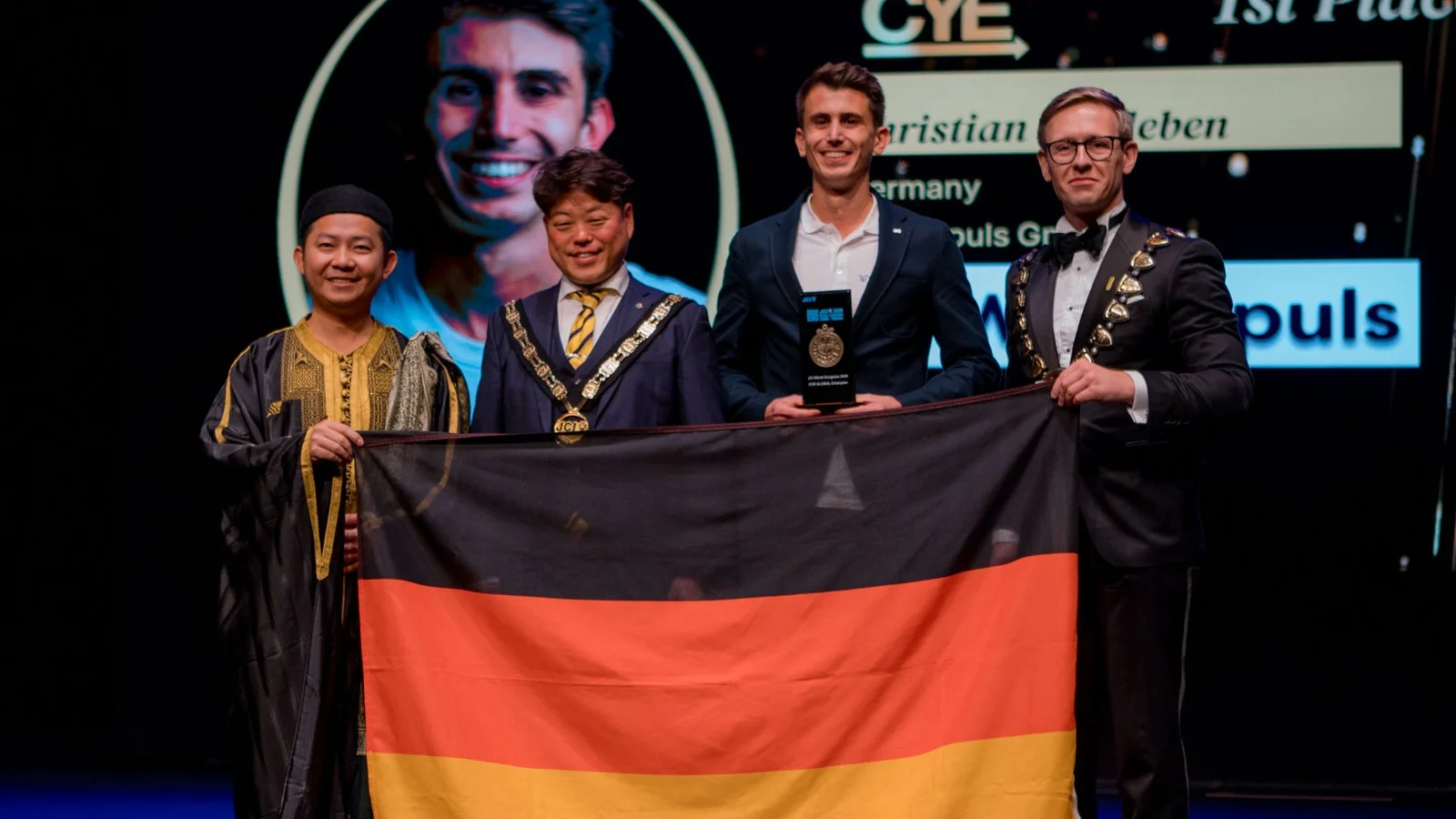
Wellenpuls GmbH, an innovative venture from JCI Germany developed by
Christian Senfleben, creates accessible, evidence-based wearable
technologies that enable individuals to strengthen their core
muscles easily and independently in everyday life. Designed for both
private users and corporate health programs, Wellenpuls makes
effective back health support simple, time-efficient, and practical.
Earning the title of 2025 CYE Winner marked a pivotal turning point
for the venture.
Before joining the JCI Creative Young Entrepreneur program,
Wellenpuls struggled to turn its scientifically proven product into
a business that could grow, and to connect with the right corporate
partners and decision-makers in the tough health market. The program
changed everything. Winning the JCI CYE title gave the company
instant credibility and trust, which helped a lot when talking to
employers, health insurers, and industry partners. Meeting
entrepreneurs from around the world also opened the founder’s eyes
to the fact that back pain is a global problem, not just a German
one, and inspired a strong drive to expand internationally.
Since participating in the CYE program, Wellenpuls has experienced
commercial growth, with annual revenue doubling, while maintaining
focused national deployment with clear pathways for future
international scaling. Aligned with Sustainable Development Goals 3
(Good Health and Well-being), 8 (Decent Work and Economic Growth),
and 9 (Industry, Innovation, and Infrastructure), the venture is
actively solving a critical global problem: ensuring that effective
back health solutions reach the people who need them most. Through
its easy-to-use wearables and scalable corporate health programs,
Wellenpuls continues to bridge the gap in preventative health and
sustainable workplace well-being worldwide.
S.Lab, an innovative venture from JCI Ukraine founded by Julia
Bialetska, develops advanced mycelium-based sustainable packaging
that outperforms traditional polystyrene and moulded pulp,
biodegrades completely in just 30 days, and matches standard
production costs. Global scale is achieved through a decentralized
network of mini-factories powered by patented technology that
transforms agricultural waste into eco-friendly alternatives.
Earning the title of 2026 CYE European Conference Winner marked a
monumental turning point for the company as it transitioned from
early planning to active market scaling.
Before participating in the JCI Creative Young Entrepreneur program,
S.Lab faced a primary barrier in securing capital while actively
navigating its Seed Round fundraising phase. Engaging with the CYE
program and its rigorous accelerator phase reshaped this trajectory
by delivering critical pitch refinement, enabling the founder to
sharply articulate value to global investors. Furthermore, the
program provided invaluable network access that secured strategic
partners and mentors, while leveraging the prestige of the "JCI CYE
Winner" brand authority to build immediate market trust. Receiving
structured outside perspective during the program helped cut through
unnecessary distractions and confirmed that the venture was heading
firmly in the right direction.
Since participating in the competition, S.Lab has achieved
extraordinary milestones, successfully securing external capital
during its Seed Round. On the environmental front, the venture is
aiming for 85% reduction in CO2 emissions compared to Expanded
Polystyrene (EPS) alongside 99% less water usage compared to moulded
pulp. Aligned with Sustainable Development Goals 9 (Industry,
Innovation and Infrastructure), 12 (Responsible Consumption and
Production), and 13 (Climate Action), S.Lab is actively solving a
critical global problem by replacing non-biodegradable, harmful
packaging with fully compostable materials that safely return to
nature after use.
GAGA HAIR, founded by Chua Xiong Chuin (Friday) under JCI Malaysia,
stands as Malaysia’s first specialized wig brand, fundamentally
transforming wigs from hidden medical necessities into everyday
confidence, lifestyle, scalp-care, and circular-economy solutions.
Through live education, personalized fittings, strategic salon
partnerships, men's wig innovation, antibacterial wig-care
formulations, and cancer-support initiatives, the venture is
building Asia’s comprehensive and inclusive hair-confidence
ecosystem. Earning major accolades—including the 2026 CYE ASPAC
Championship and recognition as a 2024 World Congress
Finalist—marked critical milestones in the brand’s evolutionary
journey.
Before engaging with the JCI Creative Young Entrepreneur program,
GAGA HAIR faced severe growing pains and nearly closed down within
its first three months due to an unfocused business model and a
depletion of startup capital while attempting to sell an uncurated
variety of beauty products. The turning point arrived through the
CYE mentoring process and panel feedback, which drilled home the
powerful realization that "less is more." By making the hard
strategic choice to cut distractions and focus exclusively on
specialized wigs paired with real education and live commerce, the
venture shifted from a basic retail operation into a robust,
scalable ecosystem. Furthermore, capturing regional titles such as
the JCI CYE ASPAC Champion elevated brand authority, sparking
international interest and strategic partnership inquiries from
regions as far as Singapore, Cambodia & Indonesia.
Since participating in the CYE competition, GAGA HAIR has scaled
remarkably, growing its annual revenue and manpower double folds,
while widening its footprint locally and internationally. The
founder has maintained a deep-rooted commitment to the JCI network
by collaborating with JCI TOYP-recognized scientists and researchers
to develop antibacterial wig-care sprays and actively mentoring new
members to step onto the CYE stage. Aligned with vital Sustainable
Development Goals focused on health, decent work, and reduced
inequalities, GAGA HAIR has directly restored confidence to over
15,300 individuals experiencing hair loss and sponsored custom wigs
for more than 120 cancer survivors.
"The CYE program was not just a competition; it was the moment
GAGA HAIR shifted from a profit-oriented business into a
purpose-driven, sustainable hair-confidence ecosystem that
restores confidence, dignity, smiles, and helps people feel
beautiful and human again."
DON’YA Ukraine's Kitchen, co-founded by Jorgia Lindquist (JCI
Canada) and her mother Janice Krissa (JCI alumni), is a pioneering
culinary enterprise based in Edmonton, Alberta, sharing authentic
Ukrainian food and heritage while creating dignified, empowering
livelihoods. Operating cafés, catering, and a retail consumer
packaged goods (CPG) product line, the venture provides a powerful
model for inclusive economic integration and social impact. Winning
the 2026 CYE Conference of America title marked a historic
milestone, making DON’YA the first Canadian company to win the
competition and propelling the social enterprise onto the global
stage.
When entering the CYE program, the business faced significant
scaling and growth constraints as it transitioned from a grassroots
community response into a structured commercial entity.
Participating in the JCI Creative Young Entrepreneur competition
supported that growth completely. Winning the title provided immense
brand authority and international recognition, capturing widespread
media coverage and earning an official Mayor's Proclamation from the
City of Edmonton. More than just a win, a defining moment occurred
during the competition when the company realized the universal
resonance of their story; pitching to an international panel in
Antigua proved that themes of resilience, cultural pride, and human
dignity transcend cultural and geographic boundaries, transforming
international expansion from a distant goal into a new priority.
Since participating in the CYE program, DON'YA Ukraine's Kitchen has
continued to flourish, maintaining robust commercial operations with
an annual revenue of $900,000 and an expanded team of 18 full-time
staff members. The founder has channeled this success back into the
JCI community, serving as an official mentor for the JCI Canada CYE
National Competition, hosting and mentoring the JCI Edmonton local
competition, and providing one-on-one coaching to help emerging
founders refine their pitches. Aligned with critical Sustainable
Development Goals (5: Gender Equality, 8: Decent Work and Economic
Growth, & 10: Reduced Inequalities), DON’YA directly tackles
economic exclusion and displacement.
When Ukrainian women fled the war and arrived in Canada, they
collided with a rigid wall of unrecognised credentials and language
barriers. DON’YA dismantled that barrier by anchoring employment in
what these women already mastered: their cultural heritage and
recipes. Rather than demanding forced assimilation, DON’YA invited
them to cook, transforming survival into leadership. During DON’YA’s
lifespan, they have employed over thirty (30) Ukrainian newcomers,
helping them find financial independence, secure permanent
residency, and reclaim their professional dignity. As a 100%
women-owned enterprise, DON’YA delivers a powerful answer to
displacement: absolute and enduring belonging.
Waste to Wealth (W2W) Engineering, founded by Dr. Moussa Thiam under
JCI Mali, specializes in the production and sale of products made
from an innovative and durable material composed of plastic and
biomedical wastes known as ecological concrete. The venture focuses
on use cases around road development, interior decoration, and the
manufacturing of ecological slabs and paving stones, while expanding
its expertise into waste management, consulting, and environmental
assessment. Winning the 2026 CYE Africa and the Middle East title
marked a major milestone, transforming the venture's trajectory
toward international scaling and high-level institutional
partnerships.
Before entering the CYE program, the primary barrier faced by W2W
engineering was access to capital. Participating in the JCI Creative
Young Entrepreneur program and its accelerator phase directly opened
critical doors. Leveraging the "JCI CYE Winner" brand authority and
network access enabled the founder to secure high-level audiences,
including discussions with the Minister of Youth and Sport regarding
the implementation of W2W products in future development projects.
Furthermore, strategic interactions with international leaders and
judges, such as exchanges with senators from Benin and Nigeria
following the pitch, provided valuable alternative perspectives and
feedback that refined the venture's operational strategy.
Since participating in the CYE competition, W2W engineering has
achieved remarkable growth, almost doubling annual revenue, growing
its employee base from, while expanding its market footprint
nationally. On the research and educational front, the venture
strengthened its R&D phase by publishing over two scientific
articles and training more than five Master's students, with future
international collaborations planned for business expansion and
doctoral training in waste recycling. Deeply committed to the JCI
network, Dr. Thiam has mentored over 10 organizations and
associations, directly impacting more than 300 young people and
women across universities in Bamako, Sikasso, Nioro du Sahel,
Timbuktu, Dire, and wider West Africa. Aligned with critical
Sustainable Development Goals, W2W engineering is actively solving a
major environmental crisis by eliminating plastic waste and
transforming discarded materials into durable building blocks.
"The CYE program was not just a competition; it was the moment my
venture got an opportunity for international expansion."
International Cooperation and JCI Twinning
Profiles of Excellence: Lessons from the 2025 JCI TOYP Honorees
Across the globe, young and creative people are always finding new
ways to innovate, lead with compassion, and work toward lasting
change. The following profiles celebrate the 2025 global recipients,
showing how their work continues to help communities, tackle tough
global issues, and inspire future leaders to act with purpose.
Eradicating Preventable Blindness Through Telemedicine
My vision is to create a world in which geography, income, and
access to specialists no longer determine whether a person can
preserve their sight. As an ophthalmologist and the founder of OUI
Inc., I have worked to combine the Smart Eye Camera, cloud
technology, artificial intelligence, and telemedicine so that
high-quality eye care can reach clinics, schools, homes, islands,
and underserved communities worldwide. Our long-term mission is to
reduce preventable blindness by 50%.
JCI plays a uniquely important role in realizing this vision. It
is not merely an organization that recognizes leadership; it is a
global platform that connects local action with international
collaboration. Through JCI, an initiative born from a single
clinical experience in Vietnam can be shared with entrepreneurs,
policymakers, physicians, and community leaders across borders.
Over the next decade, I hope to work with JCI members to establish
sustainable eye-screening and referral systems where access
remains limited, accelerating responsible medical innovation on a
scale that no single institution could achieve alone.
On Resilience & Breakthroughs
Turning Prototype Failures Into Innovation
One of the most important setbacks in my journey occurred during
the early development of the Smart Eye Camera. Our initial idea
was simple: use a smartphone to make ophthalmic examinations more
accessible. However, we quickly discovered that the smartphone’s
built-in light was insufficient to produce images of the quality
required for clinical diagnosis—our central prototype assumption
had failed.
Rather than abandoning the project, our team returned to the
clinical problem, studied the optics, developed a new external
illumination system, and repeatedly tested the device with
physicians and patients. That failure became the foundation of our
eventual breakthrough, teaching me that innovation is not the
ability to avoid failure, but the discipline to examine it
honestly, learn from evidence, and continue improving until the
solution serves people effectively. JCI embodies this same spirit,
encouraging members to take responsibility and transform setbacks
into enduring community value.
Empowering the Next Generation
Advice for Young Changemakers
Start small and grounded
Begin with one real person and one unresolved problem. Do not
wait for the perfect title, complete funding, or absolute
confidence.
Take practical action
Listen carefully to those affected, build the smallest useful
solution, test it, measure the result, and continue learning.
The Smart Eye Camera began from free cataract surgeries in
Vietnam and grew into nearly 220,000 ophthalmic assessments.
Use JCI as a laboratory
Treat your local chapter as a space to organize projects,
manage challenges, collaborate across professions, and remain
accountable to your community. Ambition becomes truly valuable
when connected to service.
Amplifying Impact
Transferring Ideas from Local to Global
JCI can amplify social impact by building a clear pathway through
which successful local initiatives can be evaluated, adapted, and
implemented internationally. While local Junior Chambers are
deeply attuned to community needs, JCI’s global network brings
together leaders from business, government, medicine, and civil
society—a rare dual capability.
JCI can further strengthen this advantage by identifying promising
projects through local chapters, connecting leaders with relevant
experts, supporting evidence-based pilot programs, and sharing
implementation challenges alongside success stories. For instance,
a community eye-screening model using portable devices and AI can
begin with one JCI chapter and scale across island communities,
rural areas, and schools worldwide. As a JCI TOYP Honoree, I hope
to collaborate with members to turn locally proven solutions into
lasting global impact.
Visionary Perspective
Breaking Barriers Through Language and Culture
As the world becomes increasingly globalized and interconnected,
we find ourselves frequently collaborating with individuals from
diverse cultural and linguistic backgrounds. The most critical
challenge facing modern leaders is navigating these cultural and
language barriers to foster true mutual understanding and respect.
Young leaders have a unique opportunity to bridge these divides by
mastering effective communication and developing deep cultural
sensitivity. We belong to one human race, aiming to be global
citizens who treat others as we treat ourselves. Overcoming these
barriers is not merely a professional necessity; it is a vital
step toward achieving lasting global peace.
On Resilience & Breakthroughs
Turning Personal Adversity into Educational Impact
There are three pivotal moments that shaped my entrepreneurial
journey. The first was being diagnosed with dyslexia. Growing up,
I struggled with reading and learning, taking longer than my peers
to process written words. This challenge became the primary
catalyst for venturing into education, inspiring me to structure
and pace my lessons so that every student can learn effectively.
The second turning point occurred when I first launched Kunkwan.
Initially, the business struggled, signing up only about ten new
students a month—a completely unsustainable rate. Rather than
remaining distant, I changed my approach, working on the ground
with my team, distributing brochures at public roadshows, teaching
in classes, and directly gathering feedback from students and
teachers to refine our syllabus.
The third turning point came when I participated in the TOYM and
TOYP awards. Hesitant about expanding overseas due to perceived
barriers, the award preparation motivated me to broaden my
horizons. Today, Kunkwan reaches students across Southeast Asia
and beyond.
Empowering the Next Generation
Advice for Young Changemakers
Give value first
If you want to gain value, you must first be willing to
provide it to others, setting in motion a chain reaction of
positive community change.
Bridge through purpose
I started a language school with the ultimate goal of bringing
people closer together through culture and communication,
proving that purposeful education can drive meaningful impact.
Amplifying Impact
Uniting Youth Voices Through JCI
Platforms like JCI play an extraordinary role in bridging
grassroots movements and global policies. In an increasingly
polarized world driven by social media, JCI must serve as an
active beacon of hope and a leading example for youth.
By uniting young people around a common goal of making the world a
better place, JCI empowers them to realize that their destiny lies
in their own hands. When the collective voices of youth merge into
a unified message, they gain the power to influence global policy,
shape industries, and build a brighter future.
Visionary Perspective
Remembering Our Ecological Wisdom
We are facing an unprecedented collective amnesia regarding the
ecological wisdom, traditional knowledge, and cultural practices
passed down across diverse cultures—practices that have sustained
and continue to regenerate our ecology amid the climate crisis. We
need to learn how to remember: our deep relationship and kinship
with the soil cared for by our farmers, the seas braved by our
fisherfolk, and the forests and rivers stewarded by our indigenous
peoples.
We must shape our institutions and systems based on an expansive,
regenerative design woven for the protection and conservation of
our nature-cultural heritage. By empowering local stories and
communities, we can build embodied infrastructures capable of
holding this vital ecological wisdom and traditional knowledge for
the land.
On Resilience & Breakthroughs
Empathy, Care, and Collective Memory
Always create room for empathy, care, and compassion—both for your
community and yourself—in whatever project or vision you
co-create. I believe leadership is defined by the multiplicities
of measurable positive impact and the magnification of the dreams
shared with your community and country.
A true leader fights for and dreams alongside their community,
driven by a hopeful and inclusive core to ensure potentiality for
every individual. Grounded in collective memory and a shared
vision for justice—amid the systemic injustices of identity,
grief, and lived experience— leadership is the ability to remain
resilient, open, innovative, and dynamic. It is a way of being in
solidarity: a friend who listens and speaks up for those who are
discriminated against and silenced.
Empowering the Next Generation
Advice for Young Changemakers
Listen deeply and with intent
Listen to the rain, listen to the river, listen to your elders
and children. Learn how to truly listen.
Stand in solidarity
Be the voice for poets, artists, farmers, fisherfolk,
scientists, indigenous peoples, queers, and frontline
communities who are fighting for our shared future.
Amplifying Impact
Driving Tangible Economic Support to Grassroots Bearers
Working within the frontlines and peripheries of one of the
countries most impacted by climate change and systemic
marginalization, I see firsthand that we need international
platforms like JCI to drive actual fiscal support and capital
directly to emerging local leaders and cultural bearers.
Change cannot happen without material resources and economic
backing. We need tangible funding directed toward cultural and
educational programs that allow the expression, reimagination, and
continuity of traditional values. Many solutions to complex crises
like climate change begin right within local communities—working
in kinship with natural ecosystems, whether along the coast or in
highland mountains.
Visionary Perspective
Expanding Human Freedom Through LegalTech and Ethics
The defining challenge for young leaders over the next three to
five years will be to ensure that technology expands human freedom
rather than merely automating human inequality. As we enter an era
where artificial intelligence shapes access to capital, education,
justice, employment, and public services, the most consequential
question is no longer what technology can do; it is who gets to
design its limits, whose rights are protected, and whether
innovation is built for inclusion or only for scale.
This is where technology, law, and entrepreneurship must meet:
technology creates possibility, entrepreneurship turns possibility
into action, and law ensures that action remains accountable to
people. Through initiatives such as Know Your Legality (KYL),
Fairplayism, Lexpolicy, and AI-supported LegalTech platforms, I
aim to make law more understandable, proactive, and accessible for
young people and founders who have historically been excluded from
professional support. Entrepreneurship is the courage of an idea,
technology is its language, and law is its conscience. The next
generation should not have to choose between moving fast and
moving responsibly; the most enduring innovations will make
progress both intelligent and just.
On Resilience & Breakthroughs
Turning Barriers into Direction
One of the most defining moments of my journey came before any
award, platform, or international stage. As a young entrepreneur
with an idea, ambition, and a willingness to work, I lacked the
legal support needed to navigate the system around me. I learned
that a good idea is not always enough, and potential is often
delayed not by a lack of ability, but by a lack of access.
At first, that experience felt like a setback, but over time it
became the driving force behind my work. I realized that these
barriers were universal, and I did not want to spend my life
merely proving I could overcome them. Instead, I wanted to help
create a world where fewer people had to face them in the first
place—transforming disappointment into a purpose larger than
myself. Overcoming a barrier is success, but ensuring it does not
exist for others is leadership.
Empowering the Next Generation
Advice for Young Changemakers
Be useful before you are important
Do not wait for a grand title, a large platform, or perfect
conditions to begin. Notice a problem that has become ordinary
for everyone else and refuse to accept it as inevitable.
Build with, not for, the people
Choose one real challenge in your community, listen long
enough to understand it, and take responsibility. The people
closest to a problem are its most important authors.
Redefine contribution
Do not measure your impact by applause or scale alone, but by
whether someone can make a safer decision, preserve their
dignity, or access an opportunity because you chose to act.
Amplifying Impact
Elevating Grassroots Leaders as Equal Architects
The hardest gap to bridge is not the distance between the local
and the global, but the distance between those who live with the
consequences of decisions and those who make them. Grassroots
leaders understand problems as lived realities, yet they are too
often invited into conversations only after the agenda has already
been shaped.
JCI must reverse that order by making proximity to a problem a
qualification for shaping its solution. International platforms
should establish direct pathways through which local leaders
co-design policy and investment priorities not as beneficiaries or
symbolic voices, but as equal architects of change. A global
solution earns its name only when the people closest to the
problem recognize themselves in it.
Visionary Perspective
Bridging Knowledge and Action in Polar Science
Over the next three to five years, I believe the greatest
opportunity for young leaders in polar science is to close the gap
between knowledge and action. We already know that the polar
regions are changing rapidly, with consequences that extend far
beyond the Arctic and Antarctic. Yet polar observations and
climate science often remain disconnected from policy, economic
decision-making, technology development, and the wider public,
compounded by geopolitical uncertainty and shifting funding
landscapes.
Young leaders must therefore do more than produce excellent
science; we must build stronger links across disciplines,
countries, communities, and decision-makers, create innovative
observation methods, and inspire the next generation of
researchers. My own experience crossing Greenland via snowkite to
collect snow-density data taught me that meaningful progress
requires keeping moving, measuring, and adapting. The ultimate
opportunity is to turn scientific understanding into collective
action—framing polar research not as a niche interest, but as an
essential investment in our shared, sustainable future.
On Resilience & Breakthroughs
Redefining Persistence Through Crisis
One of the most important lessons in my journey is that resilience
is not about how long you can endure, but having the clarity to
know what must never be compromised, the courage to change what no
longer works, and the discipline to keep moving when the path is
uncertain. When financial constraints reduced opportunities for
Arctic fieldwork, we adapted by integrating satellite
observations, artificial intelligence, and machine learning to
sustain our research.
That lesson became intensely personal during a Greenland
expedition when a teammate developed frostbite, forcing us to
evacuate and set aside our research objectives around the same
period I experienced the loss of a friend. In extreme
environments, ambition and vulnerability force a clear
realization: when not everything can be saved, changing course is
not the opposite of commitment, but its highest form—protecting
people and preserving the larger purpose. In a world of
uncertainty, the leaders who matter most are those who know what
is worth holding onto when everything else must change.
Empowering the Next Generation
Advice for Young Changemakers
Discover your unique contribution
Do not rush to change the world before understanding what you
can uniquely offer. Use experiences, unfamiliar challenges,
and diverse collaborations to reveal your strengths and
limitations.
Observe carefully and build trust
Look closely at nature, science, and society to spot patterns
and gaps. Be willing to contribute before asking what you will
gain, communicating openly to build lasting credibility.
Start where you are
You do not need a global mission from day one; start with the
people and problems around you, keeping curious and refining
your impact.
Amplifying Impact
Turning Visibility into Access and Opportunity
International platforms like JCI can make the greatest difference
by ensuring that talent is not limited by access. Grassroots
communities possess immense ideas and resilience, but often lack a
bridge to global networks, mentors, and funding. Coming from a
disadvantaged background where science was a difficult path, I
know firsthand how critical international networks are in opening
doors and turning ideas into reality.
JCI's role should be to bring people together who would otherwise
never meet, turning those connections into mentorship,
cross-border collaboration, and real pathways to implementation.
At the same time, this bridge must flow both ways, ensuring
grassroots priorities shape global decisions. Much like
researchers in Antarctica sharing data across borders because the
purpose transcends any single institution, JCI can use its global
network to find potential, remove barriers, and transform local
action into wider change.
International Cooperation and JCI Twinning
Bridging Borders through JCI Twinnings
The stories below show how these partnerships make a real difference
throughout our global network. Each initiative is based on clear Plans
of Action and supports JCI’s Four Areas of Opportunity. These efforts
include cross-border projects, leadership exchanges, and local
teamwork. Together, they show how JCI members achieve shared goals,
create lasting change, and help our organization and its members grow.
Separated by a mere 80 kilometers, JCI Saltos del Guairá (Paraguay)
and JCI Palotina (Brazil) leveraged their geographic closeness into
an exemplary model of cross-border collaboration. Bound by common
social landscapes, parallel issues, and compatible linguistic roots
(Spanish and Portuguese), both chapters successfully unified their
neighboring communities.
To ensure the alliance remains active past annual leadership
rotations, the chapters institutionalized their partnership through
a shared digital repository, structured end-of-term handover
meetings, and the early involvement of new members in cross-border
delegation visits. This proactive continuity guarantees that the
relationship thrives as an organizational commitment rather than
depending on individual mandates.
Through continuous, active collaboration, the alliance evolved far
beyond a symbolic partnership. A key highlight took place in March
2026, when Selva Karina Villamayor Ibarrola, President of JCI Saltos
del Guairá, delivered a keynote address at JCI Palotina’s Workshop
Mulher. This gathering brought together more than 80 women to foster
leadership development and strengthen cross-border networks.
Beyond joint events, the chapters engaged in practical capacity
building and methodological exchanges. Members observed key programs
firsthand, including the grand final of JCI Palotina’s Oratória nas
Escolas. Overseeing these multi-faceted binational efforts provided
project chairs with invaluable, hands-on experience, refining their
skills in multi-currency budgeting, cross-border logistics, and
intercultural negotiation.
"Leading the partnership between JCI Saltos del Guairá and JCI
Palotina taught me that true integration does not happen on paper,
but through shared action. By uniting two sister communities just
80 km apart to turn waste into seed-embedded paper, we did not
just plant seeds in the ground, but also in the hearts of our
members. This experience elevated my professional vision to an
international level..."
Selva Karina Villamayor Ibarrola, 2026 Local President, JCI Saltos del Guairá
Featured Initiative
Project CICLO
Project CICLO - Sembremos Historias / Semeando Histórias serves as a
binational circular economy initiative that converts discarded paper
into seed-embedded handmade sheets, driving ecological awareness and
long-term regional cooperation across Brazil and Paraguay.
The strategic partnership maximized resources and amplified impact
through a complementary division of labor:
Collection Campaign & Operational Synergy
JCI Palotina spearheaded a comprehensive waste-paper collection
drive in Brazil, engaging local residents and chapter members to
gather raw materials before transporting them across the border.
Technical Transformation & Processing
JCI Saltos del Guairá managed the technical implementation in
Paraguay, overseeing paper shredding, pulp production, and the
artisanal creation of seed-infused paper.
Transfer of Methodology
JCI Saltos del Guairá shared its field-tested project framework,
offering a systematic and adaptable model that was seamlessly
implemented across both regions.
This initiative ignited lasting cultural transformations along the
border region. Educational institutions seamlessly embedded
recycling practices into their day-to-day operations to serve as
ongoing collection centers. Meanwhile, students and children
naturally developed the habit of preserving used notebooks rather
than discarding them, establishing a continuous cycle of raw
material for subsequent paper production.
$100
Budget
150
Direct beneficiaries, including JCI members, local students, and
families
Over 50 kg
Waste paper rescued
Over 1,000
Individuals reached through digital campaigns
4
Strategic partner institutions engaged (schools, businesses, and
municipal entities)
Sustainable Development Goals
Founded in 2025, the alliance between JCI Jaraguá do Sul (Brazil)
and JCI Tosagua (Ecuador) reflects a commitment to driving
cross-border collaboration throughout America. Rather than relying
on isolated events, the two chapters established a continuous,
multi-year partnership. This ongoing cooperation has evolved from
early efforts such as ELO Talks into impactful flagship programs
like Passaporte Latino, along with international delegation
exchanges linked to the University Debate Project.
Managing international twinning partnerships substantially enhanced
the project chairs' capabilities in leadership, negotiation, and
cross-border project management. Directing joint initiatives between
Local Organizations in different countries demanded ongoing
communication, strategic alignment, adaptability, and cultural
awareness.
Beyond daily operations, managing these international collaborations
strengthened their ability to guide cross-cultural teams and
cultivate enduring partnerships. This practical experience in a
global setting equipped project leaders to direct increasingly
complex initiatives and expanded their capacity to generate lasting
impact through international cooperation.
"Leading our twinning initiatives has been one of the most
rewarding experiences of my JCI journey. Working with members from
another country challenged me to communicate more effectively,
adapt to different perspectives, and build trust across cultures.
It showed me that true leadership is about creating meaningful
connections and working together toward a shared purpose..."
Vanessa de Fátima Pinheiro de Castro, JCI Jaraguá do Sul
Featured Initiative
Passaporte Latino
Designed to promote cultural exchange and enhance international
networking, Passaporte Latino provides Spanish language instruction
to members of JCI Brazil, while simultaneously opening doors for
business exploration and cross-chapter collaboration between JCI
Jaraguá do Sul and JCI Tosagua.
To sustain regional progress while strategically leveraging
available assets, the partnership:
Volunteer Expertise & Instruction
Native Spanish speakers from JCI Tosagua served as volunteer
instructors and conversational partners, providing high-quality
language training without requiring paid staff.
Program Coordination & Engagement
JCI Jaraguá do Sul managed overall project administration,
participant registration, and member outreach across Brazil.
Cross-Border Opportunities
This joint initiative created international mobility pathways,
including a fully funded exchange to Ecuador for a JCI Jaraguá
do Sul participant through the University Debate Project
framework.
This initiative brought together emerging leaders from Brazil and
Ecuador by encouraging cross-cultural conversations and sharing
global viewpoints. It built lasting professional networks to support
future business, civic, and international partnerships, and also
helped organizers improve their skills in logistics, communication,
and working with partners across borders.
The collaboration made a lasting difference by creating a
language-exchange program that can be used by others. This framework
has already been shared with chapters in the United States and
Paraguay, helping to build a culture of global citizenship, ongoing
learning, and international teamwork led by members.
$834
Budget generated through participant contributions
$334
Financial surplus to be reinvested in the growth and
sustainability of JCI Jaraguá do Sul
34
Participants reached directly: 17 from Brazil, spanning more
than 10 JCI local organizations across Brazil, and 17 from
Ecuador
Sustainable Development Goals
The partnership between JCI Dalat (Vietnam) and JCI Suwon (Korea) is
built on mutual respect, deep brotherhood, and cultural
appreciation. This collaboration connects a dynamic, emerging
chapter with JCI Suwon, an established Korean organization bringing
more than 74 years of expertise in governance and leadership.
To keep the partnership strong and smooth during yearly leadership
changes, both organizations follow a set routine of annual visits.
JCI Suwon visits Dalat every January, and JCI Dalat visits Suwon
every April. Each visit includes a formal two-hour Board of
Directors meeting to align on goals, and also involves new and
emerging leaders early to build lasting trust.
The alliance helps members grow and work together by running
valuable joint programs. In April 2026, the chapters held their
first business-matching event to help entrepreneurs find
international opportunities. JCI Suwon Local President Hwang
Jeong-Hwan also led an online seminar for JCI Dalat members about
Korean consumer behavior and tourism trends, which was especially
useful for Vietnam's hospitality and travel business owners. Leading
these projects gave the project chairs more experience in strategic
planning, international diplomacy, and cross-cultural communication.
"Seeing entrepreneurs from both chapters introduce their
businesses, discover new partnerships, and become excited about
expanding internationally reminded me that JCI is not only about
friendship—it is also about creating REAL OPPORTUNITIES for
members to grow. This project strengthened my leadership,
broadened my international perspective, and reinforced my belief
that TRUST and BROTHERHOOD can create lasting business and
personal impact."
Do Quynh Minh Trang, 2026 Vice President of External Affairs, JCI Dalat
Featured Initiative
"Chú Cuội Về Làng" Community Library Project
Chú Cuội Về Làng" Community Library Initiative is designed to expand
educational opportunities and provide children in remote communities
with access to books and learning materials. This project focuses on
constructing a sustainable library network using repurposed shipping
containers, guided by a strategic five-year development roadmap
spanning 2023 through 2027.
By establishing a coordinated division of responsibilities, the
strategic alliance effectively combined capabilities and maximized
overall project outcomes:
Global Volunteer Collaboration
A delegation of ten members from JCI Suwon traveled to Vietnam,
joining forces on the ground with two volunteers from the
broader JCI Vietnam network.
Joint Resource & Financial Support
JCI Suwon contributed financial backing and sponsorships,
including VND 10,000,000 alongside children's literature and
educational toys, to enhance local fundraising efforts and
project implementation.
Cross-Sector Alignment
The initiative worked in close coordination with corporate
partners, the Lam Dong Youth Union, and local municipal
authorities to build expanded learning infrastructure.
The collaboration set up lasting educational spaces like container
libraries and computer labs in Dam Rong and Lac Duong Districts,
bringing long-term benefits. With a five-year plan from 2023 to
2027, the project built partnerships across different sectors and
helped local people develop digital skills and learn on their own.
By giving schools and communities a sense of ownership, these
programs are set up to continue on their own for many years.
$16,882
Total funding and sponsorships
$8,000
Vital medical equipment
$4,000
20 desktop computers
$2,500
Over 200 sets of textbooks and learning materials
Over 600
Primary recipients benefited
124
Active participants
17.1%
Membership growth
Sustainable Development Goals
Formed in 2018, the alliance between JCI East Saigon (Vietnam) and
JCI Anseong (Korea) represents a thriving commitment within the
Asia-Pacific region. Over the years, this relationship has grown
into a lasting partnership. Both sides regularly visit each other's
chapters, share cultural experiences, build trade connections, and
work together on civic projects in both countries.
Instead of depending on specific presidential terms, the partnership
stays strong through ongoing personal connections, shared long-term
plans, and projects that run throughout the year between Vietnam and
Korea.
The alliance encourages cross-border teamwork through important
projects. In 2019, the chapters started The Reach, bringing together
resources from both countries to build the Doi Thua Thien Bridge in
Vietnam, which made daily travel safer for rural families. The
partnership kept growing, and in 2026, JCI East Saigon and JCI
Anseong in Korea worked together to organize a big Children's Day
event for about 1,000 people, with support from local government.
Leading these international projects helped project leaders quickly
improve their skills in cross-cultural communication, fundraising,
working with different groups, and managing projects.
Featured Initiative
The Reach
"The Reach taught us that twinning is not simply about connecting
two chapters. When we combine our resources, cultures, and
leadership toward a shared purpose, an international friendship
can create an impact that continues long after the project
itself."
Nguyen Thi Kim Kieu, 2018 Local President of JCI East Saigon
The Reach initiative helps people in rural Vietnam travel safely and
reach important places by building much-needed bridges. It also
brings together young people from Korea and Vietnam to work together
and build strong partnerships.
Local Coordination & Implementation
JCI East Saigon contributed local knowledge, community
engagement, project coordination, and on-the-ground
implementation capacity in Vietnam.
International Fundraising & Support
JCI Anseong mobilized its members and broader network in Korea,
including organizing dedicated fundraising events, to secure
financial support and international backing.
Blueprint Transfer
The success of the initial bridge paved the way for JCI East
Saigon to export and replicate the community bridge-building
model across multiple underserved provinces in Vietnam.
The construction of the Doi Thua Thien Bridge helped the initiative
achieve long-term sustainability in two ways. First, it gave the
local community a permanent, safe, and reliable way to get around
and support their daily lives and economic activities, without
needing ongoing support from JCI. Second, it set up an
organizational model that allows JCI East Saigon to keep building
bridges and making a difference in the community through 2026.
$14,000
Budget
Over 70
Rural households impacted directly through infrastructure
development
Over 5,500
Families benefiting across subsequent deployments
Roughly 1,000
Participants during joint community events in Korea
Sustainable Development Goals
The partnership between JCI Sidi Mansour (Tunisia) and JCI Festac
(Nigeria), with support from JCI Sfax, addressed a modern and often
overlooked crisis that affects young professionals worldwide:
digital clutter, cybersecurity risks, and the environmental impact
of unchecked cloud storage.
To make sure the partnership stayed strong even as leaders changed
each year, both organizations set up a formal handover process. They
used clear documentation, managed committees together, and held
strategy meetings before each new term to keep the project on track
and aligned.
Featured Initiative
CLEAN AM!
Facing this challenge together, the chapters launched CLEAN AM!, a
21-day international campaign focused on digital responsibility. The
campaign followed three phases: Awakening, Action, and Mobilization.
Members joined a 90-minute virtual skills-exchange workshop,
attended expert-led cybersecurity masterclasses, and took part in
hands-on workflow-automation training.
Running a campaign across different time zones helped the project
chairs improve their skills in negotiation, aligning stakeholders,
and working together virtually.
"Directing CLEAN AM! as a twinned initiative pushed me far beyond
running a single-chapter project. I had to coordinate across time
zones, align two chapters' priorities into one coherent 21-day
program, and lead a live cross-border event... It sharpened my
project management instincts, forced me to negotiate compromises,
and taught me to lead a team I couldn't just walk over to and talk
to in person."
Bilel Abdelmaksoud, Project Director, CLEAN AM!
The strategic partnership maximized resources and amplified impact
through:
Operational Synergy & Shared Venues
JCI Sidi Mansour and JCI Sfax split the operational load of
running multi-day expert technical programs, securing venues
like Centre Ma Chance and drawing on specialized consultants.
Cross-Border Rollout
Partnering with JCI Festac allowed cybersecurity and digital
hygiene content to be cross-tested across two distinct markets
while running parallel impact frameworks.
Blueprint Transfer
JCI Sidi Mansour exported its proven three-phase campaign
architecture (Awakening → Action → Mobilization) as a
standardized operating framework for JCI Festac's rollout in
Nigeria.
Participants took part in practical, interactive sessions that
offered hands-on training in cybersecurity, N8N workflow automation,
and AI-driven tools. Instead of focusing on short-term compliance,
the initiative highlighted repeatable practices like password
hygiene, digital media clean-ups, and notification audits to help
build lasting personal routines. Attendees also connected directly
with industry experts Yassine Masmoudi and Fahmi Chaabouni, gaining
solid technical foundations and professional networks they can use
on their own after the JCI programs.
This collaboration made a lasting difference by creating a permanent
and scalable framework for digital responsibility. It helped young
people develop sustainable digital hygiene habits and gave them
practical technical skills they can use for long-term independence.
$0
Budget: the alliance leveraged high-value in-kind expert
contributions, including cybersecurity masterclasses and N8N
workflow-automation training
320
Active participants
Sustainable Development Goals
JCI Mopti (Mali) and JCI Sfax (Tunisia) have partnered for several
years, linking West and North Africa to create positive change. Both
chapters are dedicated to youth empowerment, civic responsibility,
and early leadership, building a strong base for international
collaboration.
Both organizations rely on a strong structure to keep things running
smoothly during yearly leadership changes. They use clear
documentation, organized handovers, liaison officers, and regular
online meetings to stay aligned. New leaders get direct briefings,
and Past Presidents, Senators, and senior advisors stay involved to
help keep important knowledge and experience within the
organization.
The partnership helps members grow by planning together, creating
educational materials, and offering professional development.
Members join cross-border mentoring, internships, and skill-sharing
programs in areas like civic awareness, environmental
responsibility, first aid, and modern teaching methods. Leading this
international project has helped leaders quickly improve their
skills in cross-cultural leadership, negotiation, and working with
different groups.
Featured Initiative
Élève Citoyen Modèle (Model Citizen Student)
The program Élève Citoyen Modèle engages educators, families, and
students as key partners to foster safer, more sustainable learning
environments. By instilling respect, civic duty, discipline, and
contemporary educational methods, the initiative directly supports
the goals of Mali's National Civic and Values Education Programme
(PNEV).
Complementary Expertise
JCI Mopti contributed its extensive experience in civic
engagement and community-based awareness, while JCI Sfax brought
North African educational perspectives and youth-development
practices.
Shared Educational Content
Both chapters collaborated on content development, combining
environmental awareness, first aid, safety, and modern
pedagogical approaches.
Institutional Alignment
The alliance leveraged its combined networks to coordinate with
educational authorities and align with national civic values
frameworks.
"Leading this twinning initiative has been a transformative
experience for me, both personally and professionally. Working
with JCI Sfax taught me that effective leadership goes beyond
managing a team; it requires listening, understanding different
perspectives, building trust and finding common ground across
cultures..."
Bourama Teme, Project Director, JCI Mopti
The project aimed to help beneficiaries move from being passive
recipients to becoming active contributors to its long-term success.
By taking part in practical awareness activities, interactive
lessons, and first-aid training, students learned important safety
skills and civic responsibility that they can keep using and share
with others. The "Élève Citoyen Modèle" approach also supports this
by recognizing and encouraging outstanding students to act as role
models and promote responsible behavior in their schools even after
JCI's main involvement is over.
Teachers took part in workshops on modern educational tools to use
in their daily work, and parents were included to help connect
citizenship education at school with what happens at home. The
project uses a train, empower, and replicate approach, giving key
people the skills to work on their own and inspire others. The
methods developed can be adapted for future needs. In the end, the
project’s sustainability depends on local ownership, with JCI
starting the process and students, teachers, parents, and schools
continuing to uphold these values.
$1,000
Budget
1,060
Beneficiaries reached directly, including students, teachers,
and educational authorities
Sustainable Development Goals
Featured Initiative
Future Leaders
Future Leaders build key capabilities in children, including
leadership, communication, teamwork, and problem-solving, by
delivering engaging educational workshops that foster global
cooperation and cultural understanding.
Methodology Co-Development
Both chapters pooled their educational expertise to co-create a
shared workshop framework, customizing it to fit their
respective local environments.
Shared Volunteer Manpower
Over 15 JCI volunteers collaborated across chapters to plan and
deliver the educational modules.
Resource Sharing
Chapters shared educational materials, training tools, and
communication strategies to maximize operational efficiency.
"Leading this twinning project taught me that collaboration has no
borders. It strengthened my leadership skills, expanded my
international network, and showed me the power of sharing ideas to
create a greater impact."
Project Leader, JCI Sfax
Although the initiative did not create lasting infrastructure or
change policies, it did strengthen the partnership between JCI and
the schools involved. This set the stage for future educational
projects together. The program also helped students develop
teamwork, communication, problem-solving, and leadership skills,
which they could use in their everyday lives.
Teachers also received flexible activity ideas and modern teaching
methods they could use right away in their classrooms. This helped
keep the project’s positive impact going even after the initial
launch.
$60
Budget
120
Children aged 6 to 11 reached directly
3
Primary schools
4
Interactive leadership workshops
Sustainable Development Goals
JCI Istanbul (Türkiye) and JCI Grand (Mongolia) formed a two-year
partnership that connected Europe and Asia. Their shared values
helped them build a strong relationship focused on leadership
development, environmental sustainability, and addressing water
scarcity. Together, they turned goodwill into real, meaningful
action.
To keep their partnership strong from year to year, the chapters set
up an alliance structure for the whole organization. They follow a
clear 12-month plan, hold monthly online meetings, work together in
project committees, and set clear goals. This approach helps new
leadership teams continue the collaboration and involves future
leaders early on.
The collaboration gathered significant momentum through the "Grand
Bridges Between Cultures" initiative held in Istanbul. By blending
professional networking opportunities, a Bosphorus yacht gathering,
and immersive cross-cultural exchanges, this program established a
strong foundation ahead of the official twinning agreement signing
at the JCI ASPAC Conference. Directing this multi-continental
alliance substantially enhanced project leaders' competencies in
cross-border negotiation, cross-timezone logistics, and strategic
coordination.
"Leading this twinning initiative taught me that international
partnerships are not built through signatures—they are built
through trust, shared purpose, and consistent action... This
experience strengthened not only my leadership skills but also my
belief that young leaders can build bridges that create lasting
change."
Berkay Bekar, 2026 President, JCI Istanbul
This project seeks to unite JCI Istanbul and JCI Grand in executing
a sustainable, collaborative social impact endeavor centered on
water scarcity, resource conservation, and sustainability through
joint leadership and cross-cultural exchange.
Organizational Development & Frameworks
JCI Istanbul contributed extensive experience in international
collaboration, project coordination, and structured
implementation frameworks.
Regional Insights & Sustainability
JCI Grand brought valuable local perspectives and insights into
the specific environmental and sustainability challenges within
the Asian region.
Shared Volunteer Expertise
Both chapters combined member skills, communication channels,
and coordinated volunteer efforts to co-create a scalable
cross-continental framework.
The new twinning initiative between JCI Istanbul and JCI Grand has
not yet led to policy changes, institutional adoptions, or permanent
infrastructure. However, it has already created a solid platform for
ongoing cooperation, sharing knowledge, and working together on
sustainability.
Long-term community ownership is still growing as the project is
being put into action. From the start, the project was planned to
have a lasting impact. By bringing together mixed teams, encouraging
knowledge sharing, and helping members from both organizations
develop as leaders, the partnership is building the skills needed to
keep future projects going.
The long-term goal is to give local members and partners the
knowledge, international connections, and ways to work together so
they can grow these efforts on their own. This will help create
social impact projects that can be scaled up, shape community
practices, strengthen teamwork between institutions, and bring
lasting benefits to both Türkiye and Mongolia, even after the
founding leaders step back.
$0
Budget: driven entirely by volunteer leadership and shared
chapter resources
50
Members and stakeholders engaged directly
Sustainable Development Goals
JCI Twinnings
More twinning partnerships
JCI Peninsula JCI Taichung JCI Minoh
Asia and the Pacific
The alliance between JCI Peninsula (Hong Kong, China), JCI
Taichung (Taiwan), and JCI Minoh (Japan) is a long-standing
example of regional cooperation in the Asia-Pacific. These
chapters share a focus on youth empowerment, international
friendship, and cross-cultural exchange, turning a traditional
partnership into a lively platform for regional development.
To keep the alliance strong through yearly leadership changes, the
organizations focus on building lasting relationships instead of
relying on individual presidents. They make sure important
knowledge is passed on through detailed handovers, which include
records, contacts, agreements, and event logs. International
affairs officers manage this process, with help from past
presidents, senators, and senior advisors who help preserve the
group’s history.
Blue Sky Returns connects international twinning with climate
action, hands-on learning, and sustainable community growth. It
turns JCI twinning projects into real cross-border environmental
programs that encourage young leaders to adopt low-carbon
lifestyles. The project helped local participants become
independent advocates for low-carbon living by giving them
practical tools, knowledge, and daily habits, instead of just
hosting one-time events. Through activities like the online
Eco-MBTI assessment, energy-generating cycling, recycling, and
sustainable lifestyle workshops, participants learned skills they
could use at home and at work. In addition, digital resources,
seed-paper materials, and ongoing tree-planting efforts made it
possible for participants to keep the project going and share its
impact through their own choices and social networks, without
needing direct JCI supervision.
The project reached 515 registered users on its online platform,
welcomed 171 participants at its physical exhibition, and involved
80 international delegates at the ASPAC Sustainability Forum. It
also collected 120 kilograms of reusable materials and funded a
follow-up tree-planting program in a tropical rainforest.
"Leading a twinned initiative taught me that international
affairs is not only about visits and ceremonies, but about
connecting people, ideas and action across borders. Through Blue
Sky Returns, I learned how to lead through uncertainty,
coordinate diverse stakeholders and turn a local vision into an
international conversation..."
Owen Hsu, International Affairs Director, JCI Peninsula
Sustainable Development Goals
JCI Katano JCI Honolulu
Asia and the Pacific + America
The partnership between JCI Katano (Japan) and JCI Honolulu (USA)
has been active since ASPAC 2022 and became a formal
sister-chapter agreement this year. The alliance aims to boost
business effectiveness, grow membership, and encourage cultural
exchange.
To keep things running smoothly as leaders change each year, the
chapters use international conferences like ASPAC to hold joint
LOM Nights. This helps new chairpersons connect and get on the
same page before their terms start. At the ASPAC Niigata
Conference, their teamwork stood out during Japan Night, where
they presented a food project: Hawaiian Spam rice balls made with
Katano City rice cooked in local sake. All 500 servings sold out,
sharing both cultures with a global audience. The project will
also appear at the local fall festival.
The project ran without outside grants or subsidies, using a
shared budget of $1,500, with $100 set aside for joint activities.
Starting the partnership before meeting in person also helped
project leaders quickly improve their skills in cross-cultural
communication, building trust, and working together.
“I truly experienced both the challenges and the joy of creating
something from scratch. I also realized that working with a
larger team—overcoming difficulties together rather than going
it alone—helps me grow even more. I am grateful for this
opportunity.” - Takuya Harada, President - JCI Katano
Sustainable Development Goals
JCI Conakry Trésor JCI Ouaga Metba JCI Sambava
Africa & the Middle East
This five-year alliance unites Guinea, Burkina Faso, and
Madagascar in a twinning arrangement dedicated to youth
empowerment, institutionalized through a formal charter and
comprehensive handover dossiers. Their featured project focused on
member capacity building, delivering three core thematic workshops
on leadership, finance, and artificial intelligence. By adopting
Conakry Trésor's leadership academy model and utilizing digital
tools like Mentimeter, the chapters reached 70 beneficiaries and
successfully established long-term programs to promote female
leadership.
Additionally, managing this cross-border, multi-country
collaboration significantly accelerated the project leaders'
capabilities in international negotiation, cross-timezone
coordination, and project management.
"Piloter ce jumelage m'a appris à négocier avec des
interlocuteurs que je n'avais jamais rencontrés en personne, à
composer avec des fuseaux horaires et des façons de faire
différentes, sans jamais perdre le fil... Cette expérience a
changé ma façon de voir le leadership, il ne s'agit plus
seulement de diriger une équipe, mais de construire une
confiance au-delà des frontières."
(Managing this twinning taught me to negotiate with people I had
never met in person, to deal with different time zones and
distinct ways of working without ever losing track... This
experience changed how I view leadership; it is no longer just
about leading a team, but about building trust across borders.)
Odia Oularé, Vice-President of International Cooperation - JCI Conakry
Trésor
Sustainable Development Goals
JCI Nigeria University of Abuja JCI Sidi Mansour
Africa and the Middle East
This connects JCI Nigeria University of Abuja, and JCI Sidi
Mansour, with collaborative participation from JCI El Jem in
Tunisia to promote cross-cultural understanding and leadership
growth. To keep progress steady during yearly leadership changes,
the chapters created a continuity model with clear handovers, open
communication, and shared activities in each Plan of Action. Their
main project included the Entrepreneurship Bootcamp 1.0 for
business growth and innovation, as well as the International Human
Duties Project which promoted social responsibility, and community
engagement. These efforts helped project chairs quickly build
skills in cross-cultural empathy and stakeholder management across
continents.
Serving as the cornerstone of this collaboration, the
International Human Duties Project pooled ideas and operational
experiences to build an inclusive framework supported by shared
methodologies from the Tunisian chapters on volunteer mobilization
and community coordination. The initiative directly reached 40
beneficiaries.
"Leading the twinning initiative was a transformative experience
that strengthened my ability to lead across cultures,
communicate effectively, and manage projects with diverse
stakeholders. It taught me that impactful leadership goes beyond
having a vision — it requires collaboration, adaptability, and
the ability to bring people together toward a shared goal."
Team Lead, JCIN UNIABUJA Twinning Initiative
Sustainable Development Goals
JCI Entrepreneur JCI Min Xiong
Asia and the Pacific
This partnership between JCI Entrepreneur (Malaysia) and JCI Min
Xiong (Taiwan) connects two active economic centers in Asia and
the Pacific. The collaboration is built on reciprocal visits,
member involvement, and joint projects to keep things running
smoothly as leadership changes each year. The teams organized a
4-day, 3-night project that included the JCI Entrepreneur Business
(JIB) initiative. This program gave Taiwanese delegates a close
look at Malaysia's business environment and opened up direct
opportunities for business matching and skill exchanges among
members. Completing this partnership, which was JCI Entrepreneur's
first international project, helped the project chairs quickly
build skills in international communication, cross-cultural
teamwork, and stakeholder management.
Through Asia BizConnect initiative, both chapters co-hosted
delegation events that combined Malaysian and Taiwanese networks.
They increased participation and professional exposure more than
either could alone. With a shared budget of $10,000, the
initiative funded cross-border exchanges and business networking
sessions. It reached 80 direct beneficiaries, helping
entrepreneurs and young professionals gain international market
insights and build lasting business connections.
"Leading this twinning project has been a meaningful milestone
for me and our Local Organization. This was the first
international project ever organized by JCI Entrepreneur...
Through this experience, I gained greater confidence in leading
international collaborations and learned the importance of
communication, teamwork, and building lasting friendships across
borders."
Xandra Lam, JCI Entrepreneur
Sustainable Development Goals
JCI Mitad del Mundo JCI Comayagüela
America
This twinning partnership between JCI Mitad del Mundo (Ecuador)
and JCI Comayagüela (Honduras) connects two active business
communities in the Americas. The partnership is based on a formal
agreement and ongoing communication to keep things moving smoothly
as leadership changes.
Through the joint virtual project "Conectando Emprendedores: JCI
sin Fronteras" (Connecting Entrepreneurs: JCI Without Borders),
they held a 90-minute program that included entrepreneurship
showcases, a short talk on expanding businesses across borders, a
collaboration lab, and an international opportunities market where
Ecuadorian startups met Honduran ventures offering technology and
export pathways. Without relying on outside grants, the project
directly involved 20 entrepreneurs, helping them gain visibility
and explore possible trade partnerships between the two countries.
Managing this collaboration helped the project chairs improve
their skills in planning, organizing events, and working with
international partners.
"Hoy no solo conectamos organizaciones, conectamos
oportunidades." (Today we don't just connect organizations, we
connect opportunities.)
Project Leader
Sustainable Development Goals
JCI Haiphong JCI Seoyongin
Asia and the Pacific
This 24-month partnership between JCI Haiphong (Vietnam) and JCI
Seoyongin (Korea) evolved systematically from an initial 2024
connection to a formal Memorandum of Understanding in 2025 and a
2026 Twinning Agreement. To ensure continuity across annual
leadership cycles, the alliance institutionalized a
multi-generational governance model—deliberately including past,
present, and incoming leadership during cross-border delegation
visits to preserve a unified vision.
Their collaboration culminated in JCI Seoyongin actively
supporting JCI Haiphong’s signature Drowning Prevention Project
through financial resources and project funds, while multiple
international visits honed the project leaders' capabilities in
cross-cultural communication, negotiation, and long-term strategic
alignment. This joint project addressed important child safety
risks by providing water-safety education and swimming lessons.
JCI Seoyongin’s funding, along with local support, helped the
project reach more children. The project directly reached 1,450
students through awareness sessions, provided practical swimming
instruction to 133 children.
The collaboration led to lasting changes by growing partnerships
between local governments and schools. It reached about 20,000
students in 14 schools and gave local educators and community
members the tools to run teaching programs on their own.
"I began building this relationship in 2024 as Local Director of
International Affairs, continued nurturing it as Local Vice
President in 2025, and helped transform it into an official
twinning partnership as Local President in 2026. This journey
taught me that international leadership is built through
consistency, trust, cultural understanding, and the commitment
to create opportunities that future generations of members can
continue." —Tran Thi Van Huong, JCI Haiphong
Sustainable Development Goals
JCI Kara Elite JCI Parakou Royale
Africa and the Middle East
JCI Kara Elite (Togo) and JCI Parakou Royale (Benin) built a
partnership that connected their communities through cultural and
professional exchanges. To keep things running smoothly as leaders
changed each year, both chapters created a Joint Action Plan and
held regular online meetings using Google Meet.
Their work included programs like the Immediate Past Presidents'
experience-sharing session called "Sous le Baya du Président :
Défis, doutes et délices" (Under the President's Baya: Challenges,
Doubts, and Delights), cultural hikes, and joining together for
Kara's Evala festival. By managing these activities, project
chairs learned new organizational methods, improved their ability
to work across borders, and gained valuable skills for leading
multi-chapter projects.
Through their joint initiative "La marche de l'unité" (The March
of Unity), JCI Kara Elite and JCI Parakou Royale worked together
to build stronger bonds and promote social cohesion. By sharing
knowledge, resources, and manpower, they saved time, money, and
effort. The partnership also encouraged best practices, like
starting a tradition of giving a bottle of wine to members who
keep their dues up to date. This teamwork also helped both
chapters grow and modernize by learning from each other and
meeting regularly online.
"C'est une belle expérience. Ceci m'a permis de savoir que la
gestion de projet dans mon OL a une approche différente dans
l'OL jumelle." (It's a wonderful experience. This allowed me to
realize that project management in my Local Organization has a
different approach in our twin Local Organization.)
LAWSON Djito Laté Mawusé, JCI Kara Elite
"J'ai découvert de nouveaux mécanismes pour obtenir facilement
le soutien et l'accompagnement des partenaires." (I discovered
new mechanisms to easily secure the support and backing of
partners.)
N'TCHA Urbain, President - JCI Parakou Royale
Sustainable Development Goals
JCI Pedro Juan Caballero JCI Oriente
America
The partnership between JCI Pedro Juan Caballero (Paraguay) and
JCI Oriente (Bolivia) has brought members together across America,
focusing on practical plans instead of just yearly goals.
The alliance helped members grow through joint training sessions,
including a Parliamentary Procedure Training led by 2014 JCI
Oriente President Luis Fernando Pantoja and a Strategic Alliances
Conversation hosted by JCI Pedro Juan Caballero. By sharing
knowledge and resources, the chapters offered training that
neither could have done alone. This initiative directly benefited
35 participants, helping project chairs build skills in teamwork
and negotiation between countries.
"Liderar este proyecto de hermanamiento me permitió comprender
que el verdadero liderazgo se construye a través de la
colaboración y la confianza. Trabajar junto a otra Organización
Local fortaleció mis habilidades de comunicación, planificación
y toma de decisiones, además de enseñarme el valor de construir
alianzas estratégicas para generar un mayor impacto."
(Leading this twinning project allowed me to understand that
true leadership is built through collaboration and trust.
Working alongside another Local Organization strengthened my
communication, planning, and decision-making skills, while
teaching me the value of building strategic alliances to
generate greater impact.)
Liliana Sofia Aguello Rodriguez, JCI Pedro Juan Caballero
Sustainable Development Goals
JCI Sfax JCI Warri JCI Ibadan Elite
Africa and the Middle East
JCI Sfax (Tunisia), JCI Warri (Nigeria), and JCI Ibadan Elite
(Nigeria) have worked together to empower communities and support
youth development across West and North Africa. To keep things
running smoothly as leadership changes each year, the chapters
stay in touch, create shared action plans, and hand over important
information to new teams.
For World Down Syndrome Day, they pooled their resources and
reached 15 people through creative and economic activities. The
project gave children with Down syndrome opportunities to express
their creativity, become more independent, and feel included in
their community. They made handmade products and pastries, which
were sold to help fund the center’s activities. Through this
experience, they learned new skills, gained confidence, and played
an active role in keeping the center’s services running after
JCI’s support ended.
"Leading this twinning initiative was a transformative
experience. It helped me strengthen my leadership,
communication, and project management skills while learning how
to collaborate with people from different backgrounds. This
experience increased my confidence and inspired me to take on
new challenges with a more strategic mindset."
Project Leader, JCI SFAX
Sustainable Development Goals
JCI North District JCI Kuala Lumpur West
Asia and the Pacific
This three-year sisterhood partnership between JCI North District
(Hong Kong, China) and JCI Kuala Lumpur West (Malaysia) follows a
schedule where each chapter hosts a visit every other year. The
partnership began with their Friendship Pact in 2023. Through
these annual cross-border visits, members experience each other's
local cultures, share ideas about chapter management, look into
regional business opportunities, and form lasting international
friendships that go beyond borders.
"Participating in a twinned initiative expanded my perspective
beyond local boundaries. It challenged me to adapt, collaborate
across cultures and with greater empathy, shaping me into a more
strategic and confident leader."
Annie Lee, President - JCI North District
Sustainable Development Goals
JCI Peninsula JCI City
Asia and the Pacific
The partnership between JCI Peninsula (Hong Kong, China) and JCI
City (Singapore) brings both chapters together to strengthen
cross-border leadership and develop projects that address regional
challenges in the Asia-Pacific. To keep things running smoothly as
leadership changes each year, the alliance benefits from an
experienced International Affairs and advisors who help maintain
continuity and strong relationship.
JCI Peninsula and JCI City decided to work together because both
wanted to grow their leadership and make a bigger difference in
their communities. By joining forces, members can access better
professional development and create projects that tackle regional
challenges more effectively than if they worked separately.
Sustainable Development Goals
JCI South Saigon JCI Fukuoka
Asia and the Pacific
This twinning alliance between JCI South Saigon (Vietnam) and JCI
Fukuoka (Japan) spans a decade of cross-cultural collaboration,
established in 2016 to advance youth and children's development in
alignment with bilateral ties between Vietnam and Japan.
To keep leadership transitions smooth each year, the chapters use
structured handovers, shared annual planning, early involvement of
new board members, and advice from past leaders. They stay engaged
through key joint activities like regular Local Board of Directors
(LBOD) meetings at ASPAC and World Congress, Charter Anniversary
events, and the annual J-5 Meeting in Fukuoka, which includes
business networking, company visits, and homestay experiences.
Running these international programs has helped project chairs
quickly build skills in cross-cultural communication, stakeholder
negotiation, and managing complex logistics, creating a strong
leadership pipeline for both chapters.
Running their long-term twinning initiative, the annual Bridge
Summer Camp - APCC (Asia Pacific Children Convention), has helped
project chairs grow as leaders. Each year, a Chaperon takes six
Junior Ambassadors from Vietnam to Fukuoka for a 12-day camp with
nearly 200 children from about 60 countries and regions.
Organizing this program calls for cross-cultural communication,
working with stakeholders, careful planning, risk management, and
close teamwork with international partners. Through this, project
leaders improve their decision-making, teamwork, and
problem-solving skills, and become more confident in leading
international projects and building lasting global partnerships.
"APCC did not only change the children - it changed me. It gave
me the confidence to lead with empathy, the courage to serve
beyond borders, and the responsibility to create the same
opportunities for the next generation."
Hong Dam, 2024 Local Secretary General & APCC Chaperon, JCI South
Saigon
Sustainable Development Goals
JCI Sambava JCI Conakry Trésor
Africa and the Middle East
JCI Sambava (Madagascar) and JCI Conakry Trésor (Guinea) partnered
for five years, using a formal handover process and dedicated
International Partnership Officers to keep things running smoothly
as leaders changed each year.
To address real socio-economic issues, the chapters started a
joint project for International African Women's Day. A joint
market and community needs assessment was carried out to find out
what challenges young people and women face in Sambava and
Conakry. The goal was to find, analyze, and rank the main
socio-economic challenges for young people and women in both
places, so that practical, evidence-based recommendations could be
made for public decision-makers.
Mixed teams worked together, combining local knowledge with remote
survey design and data analysis. With their combined resources and
support from local government, the project reached 60 people,
focusing on jobs for youth and women, economic empowerment, and
vocational training.
"Whatever happens, we keep moving forward."
Project Manager
Sustainable Development Goals
JCI Caaguazú JCI Tosagua
America
JCI Caaguazú (Paraguay) and JCI Tosagua (Ecuador) have worked
together to build a partnership that connects both organizations.
They share a goal of keeping their work going and repeating
successful community projects, and both are committed to making
this cross-border alliance last. To keep the partnership running
smoothly, even as leaders change each year, both chapters use
careful documentation and organized records. This helps new teams
understand the alliance’s history and plans, so nothing important
is lost.
Sustainable Development Goals
JCI San Pedro Sula JCI Quevedo JCI Santiago
America
JCI San Pedro Sula (Honduras), JCI Quevedo (Ecuador), and JCI
Santiago (Dominican Republic) worked together to connect
communities across America. Their main goals were to grow
membership, keep members engaged, and improve public speaking
skills.
To keep things running smoothly as leaders changed each year, JCI
San Pedro Sula kept detailed project records, involved its board,
and followed clear handover steps. The alliance, led entirely by
volunteers and without outside funding, ran focused training
programs. For example, they worked with JCI Santiago on ways to
recruit new members and with JCI Quevedo to use new methods like
"La neurociencia de la oratoria y debate" (The Neuroscience of
Oratory and Debate) for public speaking training. The project
directly helped 25 people.
"Liderar nuestros proyectos de hermanamiento ha sido una
experiencia transformadora. Me permitió fortalecer mis
habilidades de liderazgo, comunicación y colaboración
internacional, al mismo tiempo que comprendí el valor de
construir alianzas basadas en un propósito común..."
(Leading our twinning projects has been a transformative
experience. It allowed me to strengthen my leadership,
communication, and international collaboration skills, while
understanding the value of building alliances based on a common
purpose...)
Claudia Marcela Mejía Barrientos, JCI San Pedro Sula
Sustainable Development Goals
JCI Metropolitano JCI Wayma
America
JCI Metropolitano (Panama) and JCI Wayma (Colombia) have worked
together to connect their communities. Both chapters share a
mission to empower youth by creating economic opportunities, and
they joined forces to address the gap between skills development
and access to jobs and entrepreneurship. Both organizations use
structured planning to keep the partnership running smoothly, even
as leaders change each year. They rely on annual work plans, clear
goals, and assigned responsibilities, making sure all documents
and progress are passed on during leadership transitions. The
partnership supports member development and professional growth
with training programs, skills-exchange workshops, and networking
events. Leading this cross-border project has helped the project
chairs improve their coordination, negotiation, and project
management skills.
Under the joint initiative "Impulso 360: Empleo + Emprendimiento"
(Impulse 360: Employment + Entrepreneurship), both chapters
combined their strengths in employability and entrepreneurship.
JCI Metropolitano brought its successful "CIRPRO" project method
to the partnership, while JCI Wayma contributed its experience in
entrepreneurship. The project also gained support from the
Specialized University of the Americas (UDELAS) and formed
partnerships with groups like Business Networking International
(BNI). The project aims to support 70 young people. The goals
include helping 85% of participants strengthen their skills, 30%
find jobs, and 40% start earning income through their own
ventures.
"This partnership allowed me to strengthen my leadership,
coordination, and collaborative work skills by building a shared
vision with another local organization. More than just
developing a project, it was an opportunity to create strategic
alliances with a common purpose..."
Esmeraldha Vega, JCI Metropolitano
Sustainable Development Goals
JCI Paraguay JCI Honduras
Americas
JCI Paraguay and JCI Honduras have started a partnership that
brings together two active National Organizations from the
Americas. Both groups share a strong commitment to working
together internationally, strengthening their institutions, and
sharing best practices. They have set up a strategic plan to
support long-term growth and learning for both sides.
To keep the partnership strong even as leaders change each year,
both organizations use regular communication, written agreements,
and clear handover steps. By including several members and leaders
in these transitions, the partnership becomes a lasting commitment
for the organizations, not just for individuals.
Right now, the alliance is planning and organizing its future
activities. They are working on joint projects, training sessions,
and workshops for all members. Setting up this partnership has
already helped leaders improve their skills in working across
borders, aligning strategies, and planning international projects.
"Liderar el proceso inicial de este hermanamiento me ha
permitido ampliar mi visión sobre la cooperación internacional y
comprender el valor de construir objetivos comunes con líderes
de otras realidades."
(Leading the initial process of this twinning alliance has
allowed me to broaden my vision of international cooperation and
understand the value of building common goals with leaders from
other realities.)
Melissa Schafer Gavilán, Secretary General - JCI Paraguay
Sustainable Development Goals
International Cooperation and JCI Twinning
Global Presence and Active Participation
Global Presence and Active Participation
Empowering the Architects of Tomorrow: Youth Leadership for the 2030
Agenda
Official Co-Hosted Event with the Permanent Mission of Japan to the
United Nations
Junior Chamber International (JCI), in official partnership with the
Permanent Mission of Japan to the United Nations, successfully
convened the JCI Global Youth Summit 2026 in New York. Bringing
together young changemakers from 53 countries, the summit was
designed to dismantle institutional barriers between emerging
leaders and high-level global decision-making circles. The
initiative successfully equipped youth to transition from passive
participants into structural co-creators driving the Sustainable
Development Goals (SDGs) and the future of international leadership.
The event was attended by JCI leaders, including Alejandra Castillo
(2026 JCI President), Argenis Angulo (2022 JCI President), Elvin Teo
(JCI Secretary General), Nihal Zoroglu (2026 JCI Chief Executive
Assistant to the President), Georgina Matamoros (2026 JCI Women in
Leadership Commission Chairperson), and Marlen Wehner (2026 JCI
Skills Development Commission Chairperson).
The summit achieved extraordinary cross-sector reach, uniting
governments, international organizations, civil society, and the
private sector. Key entities engaged during the event included:
Governments & Policy Makers
The Permanent Mission of Japan to the UN, the Permanent Mission
of the Dominican Republic to the UN, and Ezio Angelini (Member
of Parliament, Venezuela).
IGOs & UN Agencies
UN Women, Office of the UN High Commissioner for Human Rights
(OHCHR), UN Foundation, UN Global Compact Network USA, SDG
Academy at SDSN, and UNICEF Generation Unlimited.
Private Sector & Corporations
RELX, Idealist, Actors Act Study, and Masdar's Youth for
Sustainability (Y4S) Program.
Global Networks & Civil Society
World Scout Committee, AIESEC, Ban Ki-Moon Foundation, BNI,
International Chamber of Commerce (ICC), US Chamber of Commerce,
and Bard NYC Centre of Studies.
Through interactive sessions, panel discussions, and collaborative
working groups, JCI steered a definitive mindset evolution across
its international delegation:
From Passive Inclusion
"How can young people be included or given a seat at
pre-existing global policy tables?"
To Structural Co-Creation
"How can global systems intentionally invest in youth as
institutional co-creators, equipping them with accessible
funding, leadership pipelines, and cross-sector entrepreneurial
ecosystems?"
JCI actively shaped the summit's narrative and strategic impact
through the following core engagements:
Hosted dynamic workshops and panels showcasing local JCI success
stories, giving delegates direct access to UN-linked global
policy dialogues and institutional experts.
Elevated the specific economic, developmental, and leadership
needs of young entrepreneurs and professionals directly to
government officials and international stakeholders.
One of the main features of the summit was the creation and
introduction of the Youth Action Resolution 2030, a shared
commitment arrived at by the participants who identified the key
priorities of the youth and set out specific actions to speed up the
achievement of the SDGs.
Moreover, the summit established the foundation for strong,
long-term partnerships, such as enhanced cooperation with Idealist,
and the initiation of new strategic discussions with UN Women in
order to plan joint activities for CSW71 in 2027.
Global Presence and Active Participation
From Representation to Authority: JCI Mobilizes Global Leaders to
Redesign Women’s Leadership Pathways at CSW70
At the 70th Session of the Commission on the Status of Women (CSW70)
at United Nations Headquarters in New York from 9 to 19 March 2026,
Junior Chamber International (JCI) played an active role by
organizing and facilitating the parallel online event, Female
Leadership Forum: Actionable Models for Women’s Leadership. JCI
brought together a diverse coalition of global youth, policymakers,
corporate leaders, and international institutions.
The forum addressed ongoing challenges to gender equality, noting
that structural barriers, cultural norms, and policy gaps still
limit women’s advancement into leadership roles. JCI used its
international network to shift the focus from increasing the number
of women leaders to transforming how institutions distribute
authority and influence.
Bringing together nearly 1,000 registrants from across 100
countries, the forum attained impressive global reach. It fostered
an inclusive, intergenerational platform uniting entrepreneurs,
emerging leaders, and young professionals aged 23 to 40.
The event brought together JCI executive leaders and well-known
figures from business, academia, and international organizations to
connect youth advocacy with policy-making. Georgina Matamoros,
Chairperson of the JCI Women in Leadership Commission, hosted the
forum. It began with inspiring words from 2026 JCI President
Alejandra Castillo and gathered a group of international
changemakers.
Keynote address insights were delivered by CSW70 Youth Steering
Committee member and public policy expert Natalia Tsuyama, along
with Monika Froehler, CEO of the Ban Ki-moon Foundation. Following
these presentations, JCI Partnerships Director Nathalia Cardenas
moderated a dynamic panel featuring industry leaders Dr. Márcia
Balisciano (RELX), Sanjana Chhantyal (UN Women 30 for 2030 Network),
Aleyna Sayin (AIESEC International), and Shannon Kobran (SDG
Academy), who examined practical strategies for women's empowerment
and sustainable growth.
The proceedings concluded with interactive Leadership Lab sessions
led by Deputy Chair Rycho Cheuk, regional representatives Virginia
De Gorostiza Gori and Rokaya Jamaly, and Past JCI Vice President
Marii Kitamura. These collaborative working groups provided
attendees with actionable leadership tools and global perspectives.
JCI actively broke down institutional silos by deliberately engaging
stakeholders across six critical sectors: Government/Policy Makers,
Private Sector/Corporations, IGOs (UN Women, NGO CSW Forum, Ban
Ki-moon Foundation), Academia/Research Institutions, Civil Society
Organizations, Youth-led Organizations and Networks
Systems over Individuals
When asked what are the biggest barriers preventing women from
advancing into decision-making roles, the responses cluster around
seven interconnected barrier: Cultural norms and gender stereotypes,
Unequal access to opportunities and networks, Confidence and
perceived readiness, Caregiving and the motherhood penalty,
Insufficient mentorship and role models, Institutional
discrimination, and Financial and educational disadvantages.
Historically, professional development for women focused on
individual adaptation. This often means encouraging women to build
confidence, find mentors, or change their behavior to fit into
existing corporate or political environments. Through the forum's
panel sessions and interactive Leadership Labs, JCI facilitated a
mindset shift among its delegation and global participants.
Targeted actions were identified to address structural drivers.
These included educational reform, support for women, and structural
changes to organizational practices. The participants’ responses
support a combined approach: shift expectations about leadership and
reform systems that determine access to opportunities. While
confidence-building and mentorship are common themes, respondents
also emphasize fair selection, stronger sponsorship, care support,
and institutional accountability.
From
"How can women develop the skills to adapt and navigate existing
leadership structures?"
To
"How must institutional architectures, governance systems, and
cultural norms transform to guarantee equitable access to
genuine authority and power?"
JCI’s Core Interventions
JCI drove the event's success through a four-pronged approach:
Convened cross-sector experts to dissect the mechanics of
institutional bias and glass ceilings.
Elevated the localized, real-world challenges faced by young
women leaders directly to global institutional stakeholders.
Connected international youth networks with corporate
sustainability executives and UN-affiliated entities.
Hosted multilingual, action-oriented breakout rooms where
participants moved past theory to co-create practical, 12-month
leadership action plans complete with measurable indicators.
This parallel event provided JCI delegates with direct access to
global changemakers. Members actively collaborated with UN advisors,
sustainability leaders, and international youth peers. Through
Leadership Labs, they identified regional barriers and developed
practical, culturally relevant strategies for immediate
implementation in their organizations and communities.
Although the forum operated independently of formal UN declarations,
the global insights, recommendations, and frameworks developed in
the multilingual breakout sessions directly supported key global
targets.
Sustainable Development Goals
Eliminating systemic barriers to ensure women’s full and
effective participation and equal opportunities for leadership
at all levels of decision-making.
Advocating for equitable corporate pipelines, sponsorship
mechanisms, and equal pay for equal work.
Demanding inclusive governance systems and institutional
accountability to dismantle gender bias.
Cultivating robust, multi-stakeholder alliances across civil
society, youth leadership, and international foundations.
Global Presence and Active Participation
JCI and AIESEC Unite Global Youth Voices at ECOSOC to Reimagine
Innovation, Entrepreneurship, and Leadership for the 2030 Agenda
At the 2026 ECOSOC Youth Forum, Junior Chamber International (JCI),
in close cooperation with AIESEC International, jointly organized a
key side event called “Empowering the Architects of Tomorrow:
Synergizing Youth Talent and Entrepreneurship for the 2030 Agenda”.
Going beyond conventional panel discussions, the event acted as a
high-level collaborative incubator aimed at tackling the complex
macroeconomic challenges now facing young people — such as the rapid
transition towards artificial intelligence, the changing digital
work environment, the need to address climate change, and the
existence of structural economic uncertainty.
Opening remarks were delivered by Alejandra Castillo, 2026 President
of JCI, and Abdul Wasay, Global Vice President for Business
Development at AIESEC International, who emphasized the need to
strengthen ecosystems that support youth leadership, innovation and
entrepreneurship.
The forum addressed a major challenge in global development: the
growing gap between young people's skills and their access to
funding, mentorship, supportive business environments, and
institutional help. Moderated by Nihal Zoroglu, the panel featured:
Matthew Hunter
Partnerships Lead at UN Youth
Desiree Junfijiah
Future Generations Next Generation Fellow at the United Nations
Foundation
Alyssa Cortez Peralta
Engagement Coordinator at UN Global Compact Network USA
Somto Nwadike
President Elect of AIESEC USA
Anirudh Sistla
Chair of the JCI Sustainability Commission
Kate Landon
Executive Director of the Ban Ki-moon Foundation
JCI and AIESEC brought together changemakers from around the world
to connect the goals of economic growth, innovation, and global
partnership (SDGs 8, 9, and 17). The sessions showed that working
together is key to building sustainable career paths and helping
young people create a stronger future.
A total of 121 people registered for the event, reflecting a strong,
cross-regional network of national organizations. Delegates
represented countries from every region, including the United
States, India, Canada, China, Japan, the Philippines, Uzbekistan,
Mexico, Egypt, El Salvador, Hong Kong, Italy, Korea, Mongolia,
Nigeria, Poland, Singapore, Trinidad and Tobago, Türkiye, the United
Kingdom, Venezuela, Argentina, Bolivia, Brazil, Colombia, and the
Dominican Republic.
From Inclusion to Systemic Investment
In the past, global discussions about young people often centered on
passive integration, mainly asking how institutions could include
youth in existing structures. During the session, JCI led a clear
shift in thinking among its international delegates:
From Passive Inclusion
"How can youth talent be given a seat at the table or included
in sustainable development conversations?"
To Architectural Co-Creation
"How can global systems intentionally invest in youth as
institutional co-creators, equipping them with accessible
funding, leadership pipelines, and cross-sector entrepreneurial
ecosystems?"
JCI and AIESEC successfully shaped the ECOSOC narrative through four
core engagement areas:
01
Deconstructed institutional barriers regarding green
transitions, the future of work, and artificial intelligence
integration.
02
Elevated the localized economic bottlenecks experienced by young
innovators directly to UN-affiliated policymakers.
03
Leveraged multi-sector intelligence to map scalable frameworks
aimed at bridging the global capital and mentorship deficit.
04
Brought together the United Nations Youth Office, the UN
Foundation, the UN Global Compact Network USA, civil society,
and corporate sustainability networks to establish integrated
support pathways.
Global Presence and Active Participation
From Dialogue to Action: JCI Brings Young Leaders Together to Advance
the SDGs Through Global Partnerships
As an official virtual side event of the 2026 UN High-Level
Political Forum on Sustainable Development (HLPF), Junior Chamber
International (JCI), which holds General Consultative Status with UN
ECOSOC, organized the Global Sustainability Forum to accelerate
progress on the Sustainable Development Goals as the 2030 Agenda
approaches its conclusion. The forum attracted nearly 1,000
registrants and approximately 400 live participants from over 98
countries. It convened youth leaders, sustainability experts,
private-sector representatives, international organizations, and
development partners to translate global sustainability discussions
into local action.
Key JCI leaders guided the event, including 2026 JCI President
Alejandra Castillo, Sustainability Commission Chairperson and host
Anirudh Sistla, Chief Executive Assistant to the President and
moderator Nihal Zoroğlu, Deputy Chairperson Yudhish Rohee,
Commission members Michele Lau and Ana Karina Carrillo, and 2025 JCI
Singapore National President Akira Yasuda. JCI Secretary General
Elvin Teo and the JCI WHQ team provided support. The forum also
facilitated connections between JCI and corporate leaders such as
Dr. Márcia Balisciano (Chief Sustainability Officer and Global Head
of Corporate Responsibility at RELX) and Maggie Lee, as well as
institutional stakeholders including Renata Koch Alvarenga (Next
Generation Planet Fellow, United Nations Foundation) and Gustavo
Nascimento (SDSN Youth Advisory Committee).
The forum emphasized how youth-led leadership, innovation,
entrepreneurship, and cross-sector partnerships can address critical
issues such as clean water, clean energy, sustainable cities,
climate action, pollution and waste management, and effective
governance. Young leaders are now key drivers of the 2030 Agenda,
not merely observers.
JCI supported the agenda through several initiatives:
JCI hosted workshops and panels to highlight local success
stories. Delegates participated in a global policy discussion
aligned with the UN HLPF and engaged with sustainability
experts, private-sector leaders, international organizations,
and youth representatives from various sectors.
The forum amplified youth voices on SDG implementation and
youth-led partnerships, bringing local experiences into the
global SDG conversation and helping set priorities with peers
worldwide.
Instead of a traditional hackathon, participants joined a
broader solution-mapping session. Breakout discussions and live
polling were used to identify priorities and practical actions.
The event provided simultaneous interpretation in English,
Spanish, French, and Japanese to increase accessibility.
Sustainability Commission members led breakout discussions and
collected practical recommendations.
The forum’s impact extends beyond the virtual event. Insights and
recommendations from the multilingual breakout discussions were
compiled in a Summary of Findings to guide future SDG conversations
and Voluntary National Review (VNR) stakeholder meetings.
By completing your registration for the JCI Global Youth Summit 2026 (“the Summit”), you acknowledge that you have read, understood, and agreed to the following Terms and Conditions.
Code of Conduct Compliance
Participants are expected to comply with the JCI Event Code of Conduct and Harassment Policy at all times and contribute to a safe, respectful, inclusive, and professional environment for all participants, speakers, organizers, and collaborating institutions.
Personal Data and Media Consent
Participants consent to the collection, processing, and use of personal information for Summit-related administrative and operational purposes, including registration, communications, logistical coordination, participant management, and post-event follow-up.
Participants also grant JCI permission to use photographs, video recordings, audio recordings, or other media captured during the Summit for educational, informational, archival, communications, and reporting purposes related to the activities and mission of JCI and the Summit.
Personal data will be processed in accordance with applicable privacy and data protection laws.
Participation and Access
Participation in certain sessions, including those held at the United Nations Headquarters and partner venues, may be subject to additional security clearance, identification requirements, and capacity limitations.
Refund Policy
Refunds will be processed in accordance with the following structure:
75% refund if requested on or before May 30, 2026 (60 days before the event start date)
50% refund if requested on or before June 29, 2026 (30 days before the event start date)
0% refund if requested after June 29, 2026
Exceptions
A 75% refund may be granted in cases of documented serious illness or the death of an immediate family member.
All refund requests must be submitted in writing to [email protected] and include appropriate supporting documentation.
Refunds will be processed within 30 business days using the original payment method.
Visa Policy
Participants requiring a visa to attend the 2026 JCI Global Youth Summit are responsible for initiating their visa application process in a timely manner and ensuring that all required documentation is submitted to the relevant authorities.
JCI World Headquarters will provide an official invitation letter upon request for registered and fully paid participants. Please note that this letter is issued solely to support the visa application process and does not guarantee visa approval.
In the event that a participant is unable to obtain a visa, the following conditions will apply:
A 50% refund of the registration fee may be granted.
JCI World Headquarters must be notified in writing no later than June 17, 2026.
The refund request must include official documentation of the visa rejection, such as a letter or formal notification issued by the relevant embassy or consulate.
Requests submitted after June 29, 2026, or without valid supporting documentation, will not be eligible for any refund.
Please note:
Administrative fees, bank charges, and currency exchange differences may be deducted from the refunded amount.
Delays in visa application submission, incomplete documentation, or failure to attend visa appointments will not be considered valid grounds for a refund.
JCI is not responsible for any costs incurred related to visa applications, travel arrangements, or accommodation bookings.
Approved refunds will be processed within 30 business days and issued using the original payment method.
Participant Responsibility
Participants are responsible for arranging and covering their own travel, accommodation, insurance, transportation, and personal expenses unless otherwise expressly stated by the organizers.
Health and Insurance
Participants are strongly encouraged to obtain appropriate travel and health insurance coverage for the duration of their participation in the Summit.
JCI shall not be responsible for medical expenses, travel disruptions, or personal losses incurred during participation in the Summit.
Behavioral Expectations
Participants are expected to maintain respectful and professional conduct throughout the Summit.
Harassment, discrimination, intimidation, disruptive conduct, or behavior inconsistent with the JCI Code of Conduct may result in removal from participation and potential restriction from future JCI activities.
Complaint and Incident Reporting
Participants acknowledge awareness of the procedures available for reporting incidents, concerns, or violations of the JCI Code of Conduct and Harassment Policy.
All reports will be handled with appropriate confidentiality and seriousness.
Third-Party Services and Venues
Certain Summit activities may take place at external venues or involve services provided by third parties, including transportation, accommodation providers, or event facilities.
Such services remain subject to the operational policies and responsibility of the respective third-party providers.
Assumption of Risk
Participants acknowledge that participation in an international event may involve certain inherent risks, including travel disruptions, health-related risks, accidents, security measures, or changes in governmental regulations or entry requirements.
By participating in the Summit, participants voluntarily assume such risks associated with travel and attendance.
Limitation of Liability
To the extent permitted by applicable law, JCI and collaborating organizations shall not be responsible for personal injury, illness, delay, loss, theft, damage, or other unforeseen circumstances arising from participation in or travel related to the Summit, except where caused by gross negligence or willful misconduct.
Force Majeure
JCI reserves the right to modify, postpone, or cancel the Summit due to circumstances beyond its reasonable control, including but not limited to natural disasters, public health emergencies, government restrictions, labor disruptions, security incidents, or other force majeure events.
Acceptance
By completing your registration, you confirm that you have read, understood, and accepted these Terms and Conditions for participation in the JCI Global Youth Summit 2026.